www.asianfarmers.org

Website of the Asian Farmers Association for Sustainable Rural Development

Archive for the ‘Country: Indonesia’


Published August 29th, 2010

In the News (Indonesia): ‘Super-Extreme’ Weather Is the Worst on Record

Jakarta. Indonesia has been experiencing its most extreme weather conditions in recorded history, meteorologists warned on Wednesday as torrential rains continued to pound the capital.

All regions across the archipelago have been experiencing abnormal and often catastrophic weather, an official from the Meteorology, Climatology and Geophysics Agency (BMKG) said.

“We have reached a super-extreme level of weather this year, the first time in our history, and this is much worse than what we experienced back in 1998, when the La Nina caused extreme weather in the country,” Edvin Aldrian warned.

Read the full story at Jakarta Globe

Published August 28th, 2010

In the News: Indonesian Flour Costs Could Rise as Exporters Lose Production

Jakarta. Local flour prices could see increases as steep as 20 percent due to supply shortages from Russia and Turkey, the Indonesian Association of Sugar and Flour Traders (Apegti) has predicted.

“Prices have gone up 10 percent due to increasing demand during Ramadan and are likely to rise 20 percent after the festivities as Russia and Turkey are cutting back on exports,” Apegti chairman Natsir Mansyur said on Sunday.

He said Russia, the world’s third-largest wheat exporter, had cut exports because bad weather had disrupted production.

Read the full story at Jakarta Globe

Published July 30th, 2010

In the News (Indonesia): About 75,000 ha of rice fields converted for other purposes in Jambi

(Economic progress cannot be pursued at the expense of food security. Rice production should be supported and made profitable for farmers. Land use policies protecting rice production areas need to be passed. — Admin)

Out of 191,774 hectares of rice fields in Jambi province, about 75,000 hectares have been converted for other purposes, including palm oil and rubber plantations, over the last three to five years.

Data at Setara Foundation, which provides advocation to farmers, discloses that the fast rate of conversion was recorded in three of the 10 regencies in Jambi.

According to the data, the fastest rate of conversion took place in East Tanjung Jabung regency, Jambi’s rice production center, with conversion coverage reaching 15,000 hectares.

Read the full story at The Jakarta Post

Published July 29th, 2010

In the News (Indonesia): Farmers rally to demand revision of Plant Cultivation System law

(AFA supports API and other peasant groups in Indonesia in their struggle to uphold farmers’ rights.)

Translated from Indonesian. (Click here for original story.)

Kediri, East Java, Indonesia, July 24, 2010 – As many as 50 farmers who are members of Farmers’ Solidarity Sovereignty (Solidaritas Kedaulatan Petani or SKP), held a demonstration in front of Prison Class II A of Kediri (Lapas Kelas II A Kediri, Sabtu) in East Java, Indonesia. The peasants feel victimized by the law, which they say only serves the interests of seed companies mainly owned by foreign investors.

They therefore urged the government to revise Law No.12/1992 on the Plant Cultivation System (Sistem Budidaya Tanaman or SBT).

Law No. 12 of 1992 on Plant Cultivation System (SBT Act). They said that the law protects the interests of capitalist investors while criminalizing farmers. They cited the case of Mr. Kuncoro, a farmer from Toyorosemi village, at Ngasem subdistrict, Kediri district, East Java province.

After being accused of producing corn seeds illegally, he was finally sentenced to seven months in jail in a trial held last May 31, 2010. “Mr. Kuncoro is a victim of the SBT Act,” said Naning Yunaidah Suprawati, action coordinator (and also advocacy staff of Aliansi Petani Indonesia or API in East Java.)
(more…)

Published July 29th, 2010

Dalam Berita (Indonesia): Demo Petani Kediri Desak Revisi UU

(Menegakkan petani hak! – AFA)

Kediri, 24 Juli 2010 – Sebanyak 50 orang petani yang tergabung dalam Solidaritas Kedaulatan Petani (SKP) menggelar unjuk rasa di depan Lapas Kelas II A Kediri, Sabtu (24/7). Para petani itu merasa menjadi korban produk undang-undang yang ditengarai menguntungkan kekuatan para pemilik modal atau investor.

Karena itu mereka mendesak pemerintah merevisi Undang-undang No 12 tahun 1992 tentang Sistem Budidaya Tanaman (SBT). UU itu dinilai berpihak kepada investor dan pemilik modal yang unjung-ujungnya bisa mengkriminalisasi para petani. Itu seperti dialami Kuncoro, Warga Toyorosemi, Kecamatan Ngasem, Kediri.

Karena dituduh memproduksi benih jagung, akhirnya dia divonis tujuh bulan penjara pada sidang 31 Mei 2010. “Pak Kuncoro adalah korban UU SBT,” kata Koordinator Aksi Naning Yunaidah Suprawati, Sabtu (24/7).
(more…)

Published July 28th, 2010

In the News: Violent Land Dispute Between Indonesian Police and Farmers Caught on Tape

(This case should be immediately investigated by authorities! The rights of farmers to their land should be upheld! Land grabbing and farmer harassment cannot be tolerated!)

Jakarta. Indonesia Corruption Watch have reacted strongly to reports that police in Bengkulu Province sexually harassed and physically abused 50 villagers in Seluma district as they protested against what they claim is a land grab by the state.

ICW activist Tama Satrya Langkun, recently in the headlines after he was beaten by unknown assailants after reporting a number of senior police generals to the Corruption Eradication Commission, said they had received concerning reports of a clash between farmers from Pering Baru village and Seluma Police on Friday.

He alleged that police had sexually harassed six women, injured 20 farmers and arrested 21 people in the incident.

The villagers were protesting against state plantation firm PT Perkebunan Nusantara (PTPN) VII in a land dispute.

Read the full story at Jakarta Globe

Published July 24th, 2010

In the News (Indonesia): Rattan export limitation harms local industry

(Export limit policies for non-food agricultural products need to be rationalized to ensure a better deal for local producers. Policies allowing only certain regions of the country to export certain agricultural products should be supported by infrastructure and support services as well to meet the production targets. — Admin)

Farmers and activists demand the government revise the 2009 Trade Ministry Regulation limiting rattan exports, arguing it could destroy the domestic rattan industry.

“The regulation has limited the country’s rattan exports,” Julius Hoesan from the Indonesian Rattan Businessmen Association (APRI) said in a dialog here on Wednesday.

The regulation allows annual exports of up to 35,000 tons of semi-finished rattan.

Julius said Indonesia’s rattan consumption was only 40,000 tons per year while its potential production of natural rattan could reach 696,000 tons annually.

“What are we going to do with the rest of the rattan produced? It causes rattan prices to decline.”

Read the full story at The Jakarta Post

Published July 23rd, 2010

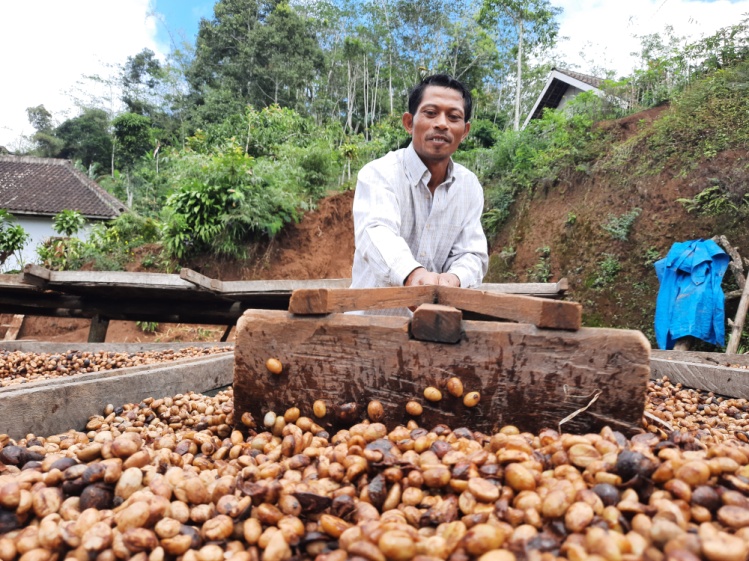
In the News: Indonesia’s Farmers are Internationally Certified to Produce Organic Coffee

(Market information for Indonesian organic coffee. — Admin)

Indonesian Coffee is famous worldwide. Indonesia is currently the third largest producer of Coffee in the world following Brazil and Vietnam. The country also ranks fourth among green coffee exporters on the global market.

According to International Coffee Organization, in 2008 Indonesia produced 561,000 tones of green coffee accounting for approximately 9% of global output. Production is decreasing because of the slowing international demand. Indonesia’s domestic Coffee consumption reaches around 190,000 metric tons annually.

The planted area for Coffee is decreasing, especially in the Robusta growing regions. This is reportedly due to lower Coffee prices. Farmers are apparently shifting from Coffee to cocoa trees, which require less maintenance and have generally provided higher, more stable prices over the past five years. It’s been noted that more and more farmers in the Lampung area – traditionally a major Coffee production area – are converting from Coffee to cocoa production.

Read the full article at Market Publishers

Published June 11th, 2010

In the News (Indonesia): Ensuring Redd is not mere pulp fiction

RECENT developments in curbing high levels of forest loss around the world are promising. They are significant because deforestation, including the clearing of trees from peat swamps in South-east Asia, is the biggest source of global warming emissions from human activity, after fossil fuel burning.

Indonesia has the eighth largest forest area on the planet and half the global total of tropical peatland. It is the world’s leading emitter of carbon dioxide and other greenhouse gases from deforestation.

So Indonesia’s announcement last month that, starting next January, it will place a two-year moratorium on new permits to clear forests and peatlands is a potentially important advance in a programme to help developing countries protect forests. In fact, advocates of the United Nations-backed forest preservation scheme, Reducing Emissions from Deforestation and Forest Degradation (Redd), argue that it is the fastest and cheapest way to cut greenhouse emissions.

Read the full story

Published March 30th, 2010

In the News: Early Dry Season in Some Regions May Affect Indonesia’s Rice Production

The Meteorology, Climatology and Geophysics Agency (BMKG) has warned that some of the country’s main rice-producing areas may be hit by an early dry season, prompting worries from farmers that their crops could be damaged and national output may fall.

Nuryadi, BMKG’s head of climate analysis, said that 19.5 percent of the country will likely face an early dry season and 30 percent of the country will face a late dry season.

The remaining 50.5 percent of the country is predicted to have a normal dry season.

For those areas hit by an early dry season, BMKG forecast that the season will begin sometime between late March and May, instead of in June as usual.

Nuryadi said farmers in key rice-producing areas, including Karawang, West Java, and southern coastal areas of West Java through Central Java, must pay attention to their farms’ water supply.

Read the full story at Jakarta Globe