
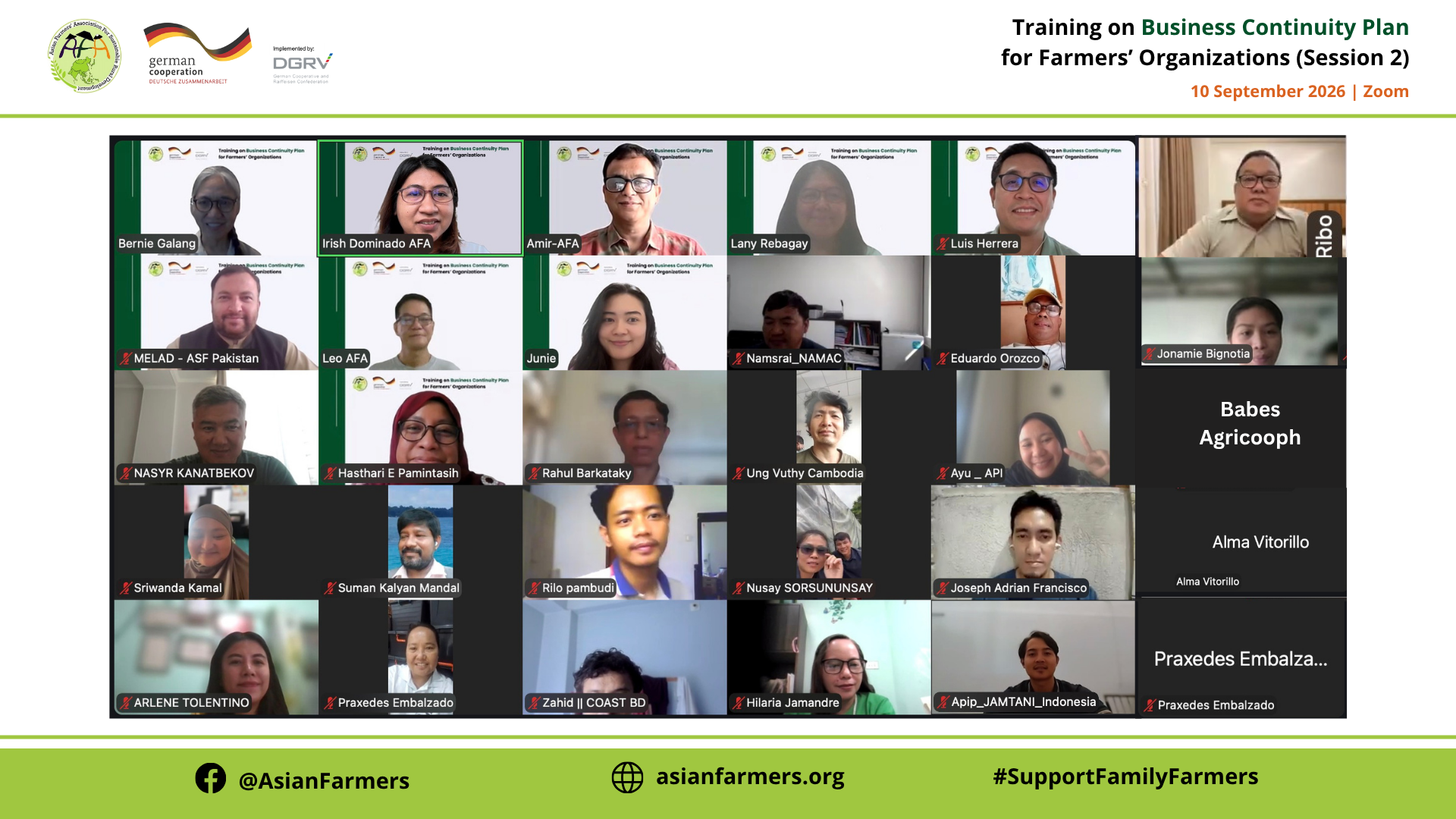
Representatives from AFA member and partner organizations gathered for Day 1 of the second session of the Training on Business Continuity Plan (BCP) for Farmers’ Organizations, organized by the Asian Farmers’ Association for Sustainable Rural Development (AFA) and DGRV.
The three-day training, held on 10,11 and 14 September 2026, aims to strengthen the resilience of farmers’ organizations by equipping them with practical tools for risk management, encouraging the exchange of experiences and good practices, and helping organizations prepare for crises and disruptions.
Led by Mr. Luis Herrera, DGRV Philippines Project Advisor, the first day focused on establishing the foundations of business continuity planning and understanding how disruptions can affect farmers’ organizations, their enterprises, and their operations.
Building the foundations of business continuity planning
The sessions introduced participants to the key elements of a Business Continuity Plan, including its scope, objectives, and policy. Herrera emphasized that organizations should focus on their main revenue-generating products and services when determining which activities to prioritize.
He also highlighted that business continuity planning can be adapted to the size, structure, and available resources of farmers’ organizations. Rather than requiring additional staff, smaller organizations can assign responsibilities based on existing roles and capacities.
Participants discussed the importance of involving farmer leaders and members in developing their organizations’ plans. The sessions also explored the roles of management, business continuity managers, and response teams in preparing for and managing disruptions.
Identifying critical activities and potential impacts
Participants were introduced to the Business Impact Analysis (BIA) process, which helps organizations identify critical business activities, their dependencies, and the resources needed to sustain operations during disruptions.
Using an impact matrix, Herrera explained how organizations can assess the severity of disruptions across different categories, including financial, reputational, and legal impacts. Participants also explored the concept of Maximum Tolerable Period of Disruption (MTPD), which helps organizations determine how long an activity can be interrupted before the consequences become unacceptable.
The discussions emphasized that impact assessments should reflect each organization’s specific circumstances, business priorities, and risk tolerance.
Learning from different agricultural value chains
As part of the hands-on activities, participants were divided into three commodity groups—grains, crops, and livestock—to examine their respective cooperative models, identify critical activities, and discuss potential disruptions.
The groups shared experiences and identified challenges across their agricultural value chains:
- Grains: The group discussed operational and financial impacts, including transportation challenges, input price increases, and human resource shortages.
- Crops: The group examined cacao production, highlighting climate change and pest attacks as potential risks and mapping activities from sourcing to post-harvest processing.
- Livestock: The group discussed milk collection in the Philippines, covering collection, testing, storage, and logistics, including seasonal considerations and government support.
These discussions provided opportunities for participants to relate the concepts and tools introduced during the workshop to the realities of their own agricultural enterprises.
Day 2: September 11, 2026
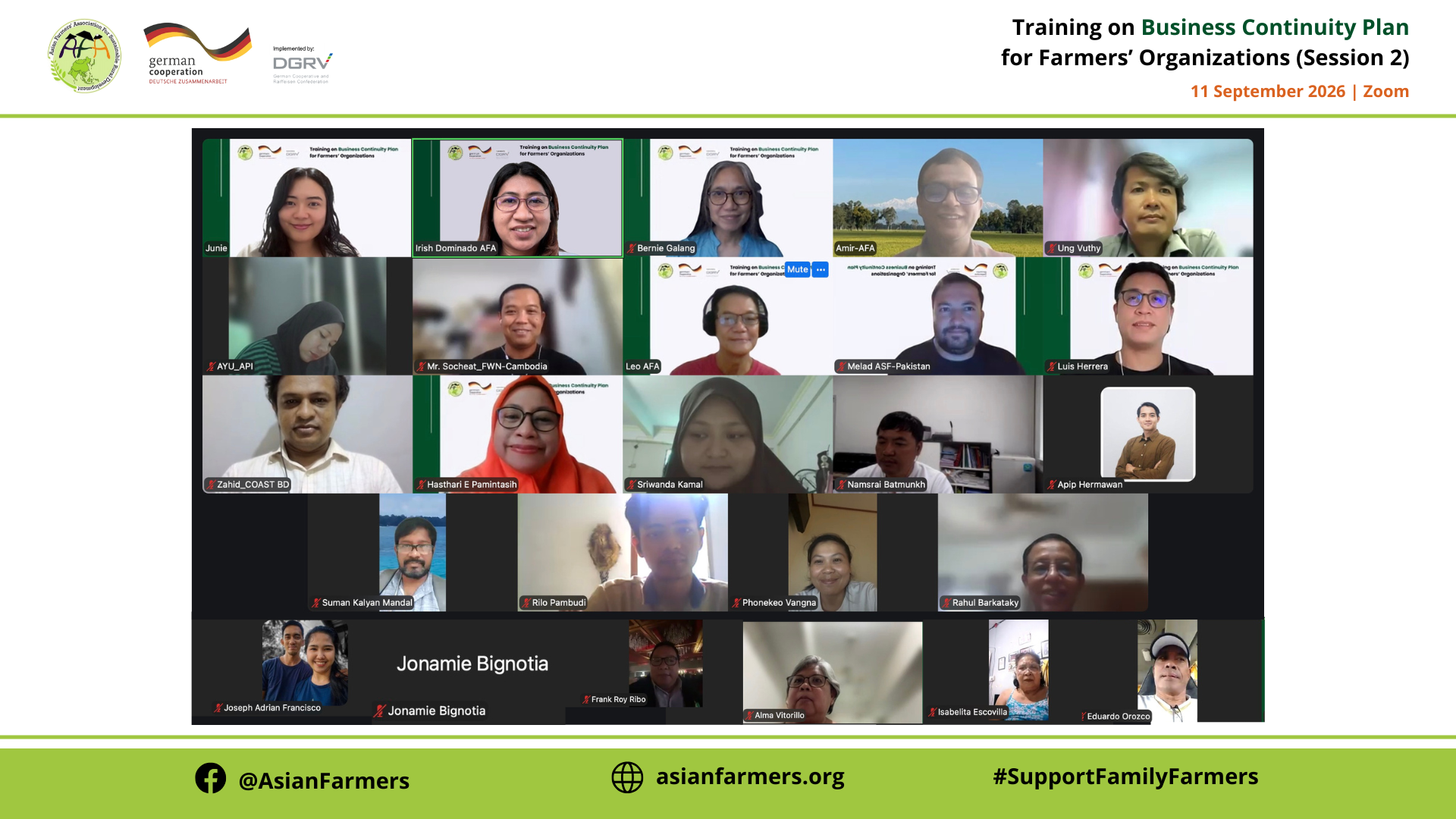
The second day of the focused on moving from business impact analysis to risk identification and assessment. The session helped participants deepen their understanding of how farmers’ organizations can identify critical activities, assess potential disruptions, and establish appropriate approaches for managing risks.
Identifying dependencies and requirements
The session began with a closer look at dependencies and requirements within a Business Continuity Plan.
Participants examined the resources needed to carry out priority activities, including facilities, utilities, people, equipment and tools, suppliers, service providers, and other business partners.
Herrera emphasized that organizations need to understand whether external providers can continue delivering essential goods or services during a crisis. Where critical activities depend on external organizations or individuals, appropriate business continuity arrangements or service-level agreements may be considered.
These dependencies form an important part of the Business Impact Analysis, helping organizations determine what is required to maintain critical activities during disruptions.
Understanding recovery priorities
Participants continued working with the BIA and BCP templates, discussing how to determine minimum operating capacity and recovery objectives.
Questions from participants highlighted the particular challenges faced by agricultural cooperatives. For example, cacao enterprises may need to consider the characteristics and potential deterioration of their products when determining recovery requirements.
The session also explored Recovery Time Objective (RTO), Recovery Point Objective (RPO), and Maximum Tolerable Period of Disruption (MTPD). Luis explained that both qualitative and quantitative approaches can be used in determining recovery objectives, with qualitative approaches being suitable for organizations beginning to develop their BCP processes.
Moving into risk assessment
Participants then moved into the risk assessment component of business continuity planning.
An interactive quiz provided an opportunity to review key BCP concepts before Herrera introduced the steps involved in setting risk criteria and identifying risks.
Using a qualitative five-point scale, participants learned how to assess risks based on their likelihood and potential impact.
The training presented nine broad categories of risks that organizations may need to consider:
- Natural and environmental risks
- People, health and safety
- Suppliers and business partners
- Financial risks
- Operations and quality
- Security
- Technology and information
- Legal and regulatory risks
- Political and social risks
Herrera used examples such as fires, typhoons, power outages, loss of key personnel, supplier failures, and regulatory issues to demonstrate how risks can affect specific business activities.
Developing a risk register
The session also introduced the risk register, which provides a structured way of documenting and managing identified risks.
Participants learned how to translate general risks into specific risk statements, assess vulnerabilities and existing controls, and determine likelihood and impact scores.
The resulting risk assessment can then guide management decisions on whether a risk should be treated, tolerated, transferred, or avoided.
Herrera reminded participants that the risk register should follow the Business Impact Analysis. By first identifying critical activities and their dependencies, organizations can ensure that their risk assessment is connected to the activities that are most important to maintaining their operations.
Day 3: September 14, 2026
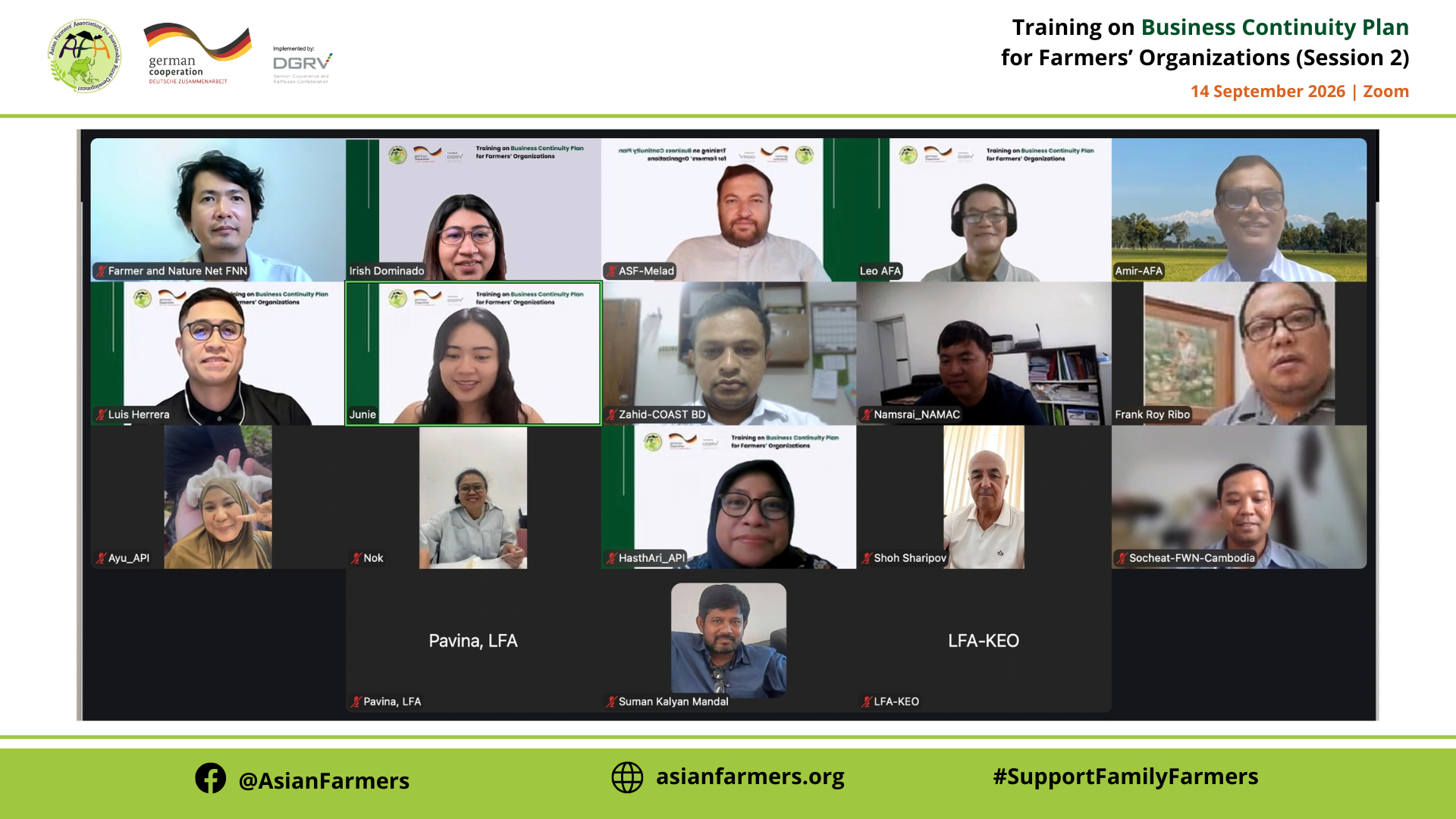
The three-day training concluded with a session focused on developing practical solutions, strategies, and procedures to help farmers’ organizations prepare for, respond to, and recover from disruptions.
From risk assessment to solutions
Building on the previous sessions on BIA and risk assessment, Day 3 focused on the next step: determining what organizations can do to manage identified risks and maintain critical operations.
Herrera used a cacao farmer organization as a case example to demonstrate how solutions can be developed for different risks and organized according to different stages of a disruption—before, during, and after an incident.
For example, risks such as flooding that could damage greenhouse facilities may require preventive measures such as improving drainage or elevating equipment, while other risks may require insurance or alternative arrangements. The loss of a major buyer, meanwhile, could require strategies such as developing alternative markets and succession arrangements.
The exercise emphasized that business continuity is not limited to responding once a crisis has occurred. Preventive and risk-reduction measures can help organizations reduce potential impacts and make recovery more manageable.
Identifying resources and responsibilities
Participants also explored the resources required to implement proposed solutions. These included personnel, equipment, financial resources, facilities, and other operational requirements.
Identifying these resources helps organizations determine whether proposed solutions are feasible and understand what investments may be needed to strengthen their resilience.
The session also introduced the organizational structures needed to implement business continuity measures, including the Crisis Management Team, Emergency Response Team, and recovery teams.
Herrera outlined four phases of business continuity procedures:
- Initial response
- Crisis management
- Business continuity and recovery
- Return to normal operations
For each phase, organizations need to establish clear responsibilities and time-bound targets to guide their response and recovery efforts.
Developing business continuity strategies
The training demonstrated how business continuity strategies can be developed around specific areas of an organization’s operations, including site and asset continuity and supply chain continuity.
Participants examined how preparedness measures, response procedures, and recovery actions can be assigned to different teams and personnel. These may include facilities recovery teams, supply chain recovery teams, and the business continuity manager.
Herrera emphasized that effective strategies should be based on the risks identified through the organization’s risk assessment and should include clear timelines, responsibilities, and coordination mechanisms.
The participants were also introduced to the structure of a BCP document, including document versioning, business continuity strategies, team structures, communication protocols, and recovery arrangements.
Testing and improving business continuity plans
A key part of the session focused on testing BCPs to ensure that plans can work in practice.
Herrera presented different approaches to testing, ranging from orientations and discussion-based exercises to tabletop exercises, desktop reviews, functional exercises, and full-scale exercises.
He recommended that organizations conduct tabletop exercises at least twice a year, alongside regular orientations for new employees. For farmers’ organizations, he also highlighted the importance of communicating business continuity plans to farmer members so they understand their roles and what to expect during a disruption.
Testing allows organizations to identify gaps in their plans and make improvements before an actual crisis occurs.
Learning from past disruptions
Participants also shared experiences of disruptions they had encountered, including earthquakes, flooding, and the COVID-19 pandemic.
These experiences demonstrated the practical value of having a business continuity plan in place. Participants noted that the absence of continuity planning during previous disruptions could contribute to management difficulties, supply chain problems, and challenges in maintaining operations.
The discussion reinforced the importance of preparing in advance rather than relying solely on reactive measures when a disruption occurs.
Turning Learning into Practical Action
Throughout the three-day training, participants were encouraged to connect the BCP concepts with the realities of their own organizations and agricultural value chains.
The sessions moved from understanding critical activities and their impacts, to identifying risks, and finally to developing solutions, strategies, procedures, and testing mechanisms.
By strengthening the ability of farmers’ organizations to identify risks, prepare solutions, establish response and recovery procedures, and regularly test their plans, AFA and DGRV aim to help organizations build stronger systems for managing disruptions and sustaining essential operations.
Business continuity planning, as emphasized throughout the training, is ultimately about helping farmers’ organizations prepare before a crisis happens—so they can continue serving their members and protecting their enterprises when disruptions occur.
Click here for more information about this training.