
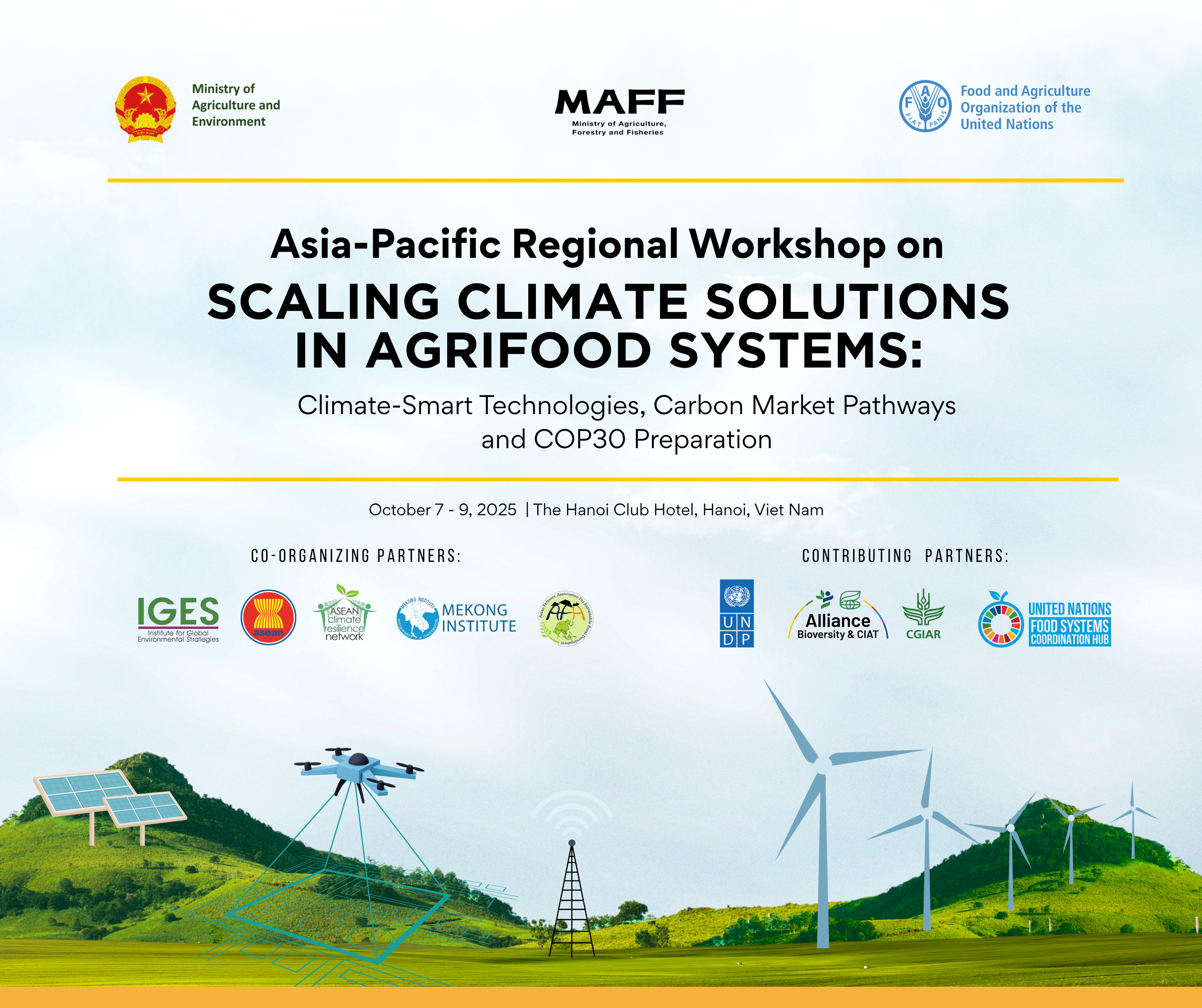
Asia-Pacific Regional Workshop on Scaling Climate Solutions in Agrifood Systems:
Climate-Smart Technologies, Carbon Market Pathways and COP30 Preparation
October 7 – 9, 2025
The Hanoi Club Hotel | Hanoi, Viet Nam
BACKGROUND
Agrifood systems in the Asia-Pacific region are increasingly vulnerable to the impacts of climate change, facing intensifying risks from floods, droughts, and shifting weather patterns. At the same time, agriculture remains a major contributor to greenhouse gas (GHG) emissions, notably methane and nitrous oxide. Yet, the sector also offers substantial potential for both mitigation and adaptation through the adoption of climate-smart technologies, innovative financing mechanisms, and evidence-based
policy support.
To unlock this potential, countries are increasingly turning to international climate finance and market-based mechanisms, where recent global decisions provide new opportunities for the agriculture sector. Recent developments at COP29 have brought clarity and momentum to international carbon markets. Countries adopted a comprehensive rulebook for Article 6.2 (cooperative approaches using Internationally Transferred Mitigation Outcomes, ITMOs) and Article 6.4 (the centralized crediting mechanism), with guidance on authorization, tracking, and registries. Stronger transparency measures — such as ITMO tagging and clearer review processes — were also agreed. Importantly, new Article 6.4 standards now allow agricultural projects to generate credits under the Paris Agreement, marking a turning point for Asia-Pacific countries to participate with greater confidence and accountability.
Over recent years, the region has witnessed growing momentum in the promotion of climate-smart
technologies and market-based financing.
The MIDORI, Paris Agreement, and Collaboration (MPAC) project, supported by the Ministry of Agriculture, Forestry and Fisheries (MAFF) of Japan and implemented by the Food and Agriculture Organization of the United Nations (FAO), has fostered regional collaboration and knowledge exchange on low-emission technologies. These include alternate wetting and drying (AWD) in rice, biochar applications, and improved livestock feed, shared through various workshops. The project has also supported policy uptake and strengthened transparency in the agriculture sector, contributing to the development of institutional frameworks and Measurement, Reporting, and Verification (MRV) systems aligned with the Enhanced Transparency Framework (ETF) under the Paris Agreement across multiple countries.
In addition, the FAO Regional Office for Asia and the Pacific (RAP), through its Technical Cooperation
Programme, is supporting Cambodia, India, the Philippines, Thailand, and Viet Nam in strengthening
their readiness to engage in international carbon markets under Article 6 of the Paris Agreement. The project builds country capacity to design mitigation activities across the agrifood sector — spanning agriculture, livestock, forestry, land use, energy, and waste — that are ready for investment.
It also supports the development of national readiness roadmaps and alignment with emerging regulatory frameworks. A key feature is the focus on adopting a landscape approach to land and carbon governance, managing land use and natural resources across broader areas to maximize carbon sequestration, reduce deforestation, and enhance ecosystem services.
Working closely with the Institute for Global Environmental Strategies (IGES), the project facilitates technical assessments, consultations, and roadmap planning at both national and regional levels. This workshop marks a key milestone to advance country-specific Article 6 roadmaps and identify next steps for piloting carbon market engagement in agrifood systems, while also providing a platform for peer learning and early engagement with potential partners. IGES, through its Article 6 Implementation Center, supports this effort by offering technical assistance, capacity building, and knowledge exchange to help countries design bilateral cooperative approaches such as the Joint Crediting Mechanism (JCM) and access carbon finance under Article 6.2.
As host of this workshop, the Ministry of Agriculture and Environment (MAE) of Vietnam has provided critical guidance and direction, ensuring that the discussions are rooted in national priorities while advancing regional and global collaboration. Viet Nam’s commitment, through both technical expertise and convening power, underscores the country’s role in steering efforts that link agrifood systems with climate resilience, finance, and Article 6 opportunities.
The United Nations Development Programme (UNDP), under the Global Climate Promise 2025, is supporting the Government of Viet Nam in developing its third Nationally Determined Contribution (NDC 3.0). This includes advancing adaptation, loss and damage, finance strategies, and just transition.
Through the Capacity Building Initiative for Transparency (CBIT) and National Adaptation Plan (NAP) support, UNDP is strengthening the Ministry of Agriculture and Environment’s (MAE) capacity to track GHG emissions, monitor adaptation, and manage climate finance — including access to the Loss and Damage Fund. UNDP also assists MAE in translating UNFCCC Article 6 into national actions, launching a carbon market, and ensuring emission reductions are verifiable and aligned with Viet Nam’s climate targets.
At the regional level, the Mekong Institute acts as Secretariat to the ASEAN Climate Resilience Network (ASEAN-CRN), a platform that promotes regional cooperation and capacity development on climate-smart agriculture. The bodies of work of the ASEAN-CRN ensure alignment with ASEAN’s regional priorities and facilitates knowledge exchange across Member States.
The Food and Agriculture for Sustainable Transformation (FAST) Partnership, a COP27 Presidency initiative, with secretariat at FAO, promotes policy coherence, capacity development, and improved access to climate finance for agrifood systems. It also serves as the COP-to-COP coordinator of agrifood system legacies, linking national readiness efforts with global partnerships and highlighting scalable solutions.
The UN Food Systems Coordination Hub supports countries in addressing persistent challenges such as conflict, climate change, and inequalities that undermine food security and livelihoods. Its Convergence Initiative, launched at COP28, helps connect food system transformation pathways with NDCs and NAPs,
promoting integrated action at national levels.
The Alliance of Bioversity International and the International Center for Tropical Agriculture (CIAT), a CGIAR center, works at the nexus of agriculture, nutrition, and the environment. Its work ranges from conserving and deploying crop diversity to developing climate-smart technologies and practices that
lower emissions and strengthen resilience. In this workshop, CIAT will focus on highlighting priority areas in global policy that require support on the road to COP30.
Equally important, the Asian Farmers’ Association for Sustainable Rural Development (AFA) ensures that smallholders’ voices remain at the center of these discussions, connecting grassroots farmer priorities with regional and global climate dialogues.
This regional workshop provides a timely opportunity to bring together governments, technical agencies, farmer organizations, and international partners to strengthen capacity, exchange experiences, and develop action plans. With COP30 approaching, where agrifood systems are expected to feature more prominently, the workshop will also help shape a unified regional voice and identify practical steps for advancing climate action in agriculture.
OBJECTIVES
The workshop will build on regional momentum, strengthen readiness for carbon markets under Article 6 of the Paris Agreement, promote climate smart technologies, and prepare for meaningful engagement at the 30th Conference of the Parties (COP30), where resilience and finance options for agrifood systems will be central to the agenda.
Specifically, the objectives are to:
- Build understanding of global and regional climate policy frameworks under the UNFCCC, including supporting national efforts to align priorities between food systems and climate actions
- Share practical and scalable climate-smart technologies and innovations
- Deepen capacity on Article 6 carbon market mechanisms, including the Joint Crediting Mechanism (JCM), and provide inputs for the draft Article 6 Readiness Roadmap for the region
- Support the development of national Article 6 readiness roadmaps for the agrifood sector
- Prepare regional positions and contributions ahead of COP30
- Facilitate the co-creation of inclusive, cross-sectoral solutions by engaging diverse stakeholder
- Convening cross-sector and multi-stakeholder dialogues to prepare regional positions and contributions ahead of COP30
EXPECTED OUTCOMES
This regional workshop is expected to strengthen national readiness, enhance cross-country collaboration, and accelerate the uptake of climate finance opportunities in agrifood systems, particularly through carbon markets and Article 6 mechanisms. It will also build shared priorities, map pathways for
partnerships and finance, and reinforce regional networks — ultimately advancing climate-resilient food system pathways and ensuring a united agrifood voice at COP30. Expected outcomes include:
- Greater awareness and technical understanding of scalable low-emission technologies.
- Shared priorities identified for aligning agrifood systems with national and global climate policies and market mechanisms.
- Coordinated engagement at COP30 to jointly advocate for agrifood system priorities.
- Opportunities mapped for collaboration through Article 6 mechanisms (e.g., JCM), carbon markets, and climate finance instruments such as GCF, GEF, FRLD, and the Adaptation Fund.
- Agreed follow-up actions for project development and partnerships.
- Strengthened regional networks and communities of practice to sustain momentum.
- Enhanced capacity to implement climate-resilient and sustainable food system pathways that integrate mitigation and adaptation across the value chain.
- Stronger capacity to operationalize the UN Food Systems Summit+4 calls to action.
TARGET PARTICIPANTS
To ensure a multi-stakeholder and cross-sectoral dialogue, the workshop will bring together a diverse group of actors engaged in climate action, agricultural development, and carbon market mechanisms. Target participants include
- Government officials from agriculture, environment, and finance ministries MDBs, IFIs
- Climate policymakers and NDC focal points for agriculture
- Food System National Convenors and focal points from participating countries
- Technical experts and researchers
- Representatives of farmer organizations and civil society
- Private sector and agri-tech innovators
- Development partners and international organizations
ORGANIZERS AND PARTNERS
This workshop is jointly organized by leading technical and development institutions working on advancing low-emission and climate-resilient agrifood systems across the region:
- Food and Agriculture Organization of the United Nations (FAO)
- United Nations Development Programme (UNDP)
- Institute for Global Environmental Strategies (IGES)
- Mekong Institute (MI)
- Japan’s Ministry of Agriculture, Forestry and Fisheries of Japan (MAFF)
- UN Food Systems Coordination Hub (UNFS Coordination Hub)
- CIAT
- Asian Farmers’ Association for Sustainable Rural Development (AFA)
Hosted by Vietnam’s Ministry of Agriculture and Environment with:
Supporting partners:
- ASEAN Secretariat
- Japanese organizations/institutions
- Regional R&D institutions
Private sector participants (invited through EoI process):
- Faeger
- Green Carbon
- CarbonFarm
- Sagri
- Ajinomoto
- Varaha
- Eco Pork
- Regrow Ag
- TOWING
PROGRAMME AT A GLANCE
DAY 1 – Tuesday / 7 October
GLOBAL POLICY ON RESILIENT AGRIFOOD SYSTEM AND CAPACITY BUILDING WITHIN THE PARIS AGREEMENT
AM
- Opening
- Session 1: Introduction to global climate change policies that impact agrifood system
- Session 2: Introduction to the Paris Agreement architecture (NDCs, LTS, ETF/BTR, GST)
- Session 3: Linking agriculture to NDC 3.0, Article 6 opportunities and long-term strategies
PM
- Session 4: Elements of Carbon Market Readiness
- Session 5: MRV for agriculture
- Session 6: Special Look on Vietnam and Forestry/Landscape Carbon
DAY 2 – Wednesday / 8 October
FINANCE AND CARBON BUSINESS DEVELOPMENT WITH CLIMATE SMART TECHNOLOGIES
AM
- Session 7: Finance for and finance from carbon markets – making projects happen and ensuring benefits flow back to producers
- Session 8: Private Sector Support for Carbon Market Development
PM
- Session 9: JCM Business Matchmaking
- Session 10: Development of a country roadmap for Article 6 readiness in agrifood systems
DAY 3 – Thursday / 9 October
DRIVING REGIONAL ACTION TOWARDS COP30
AM
- Session 11:
- 11 A – Understanding UNFCCC Processes ( COPs, CMA, SBs, formal agenda items, and COP presidential legacies)
- 11.B – Opportunities for agrifood system within UNFCCC at COP30
- Session 12 Joint Engagement at UNFCCC
- 12 A – Reflection sharing from the ASEAN Negotiating Group on Agriculture (ANGA and South Asian Policymakers)
- 12 B – Farmers meet Negotiators: Climate Action Points for COP30 Session 13: Convergence Initiative – Climate Action and Food System Transformation: Bridging Nutrition, Biodiversity, and Inclusivity from UNFSS+4 Strategies toward COP30
PM
- Session 14: Writing Exercise on Priorities for COP30
- Synthesis of COP30
- Action Points, Common Views for Agrifood System Sector
- Closing
DETAILED AGENDA
Comments are closed