
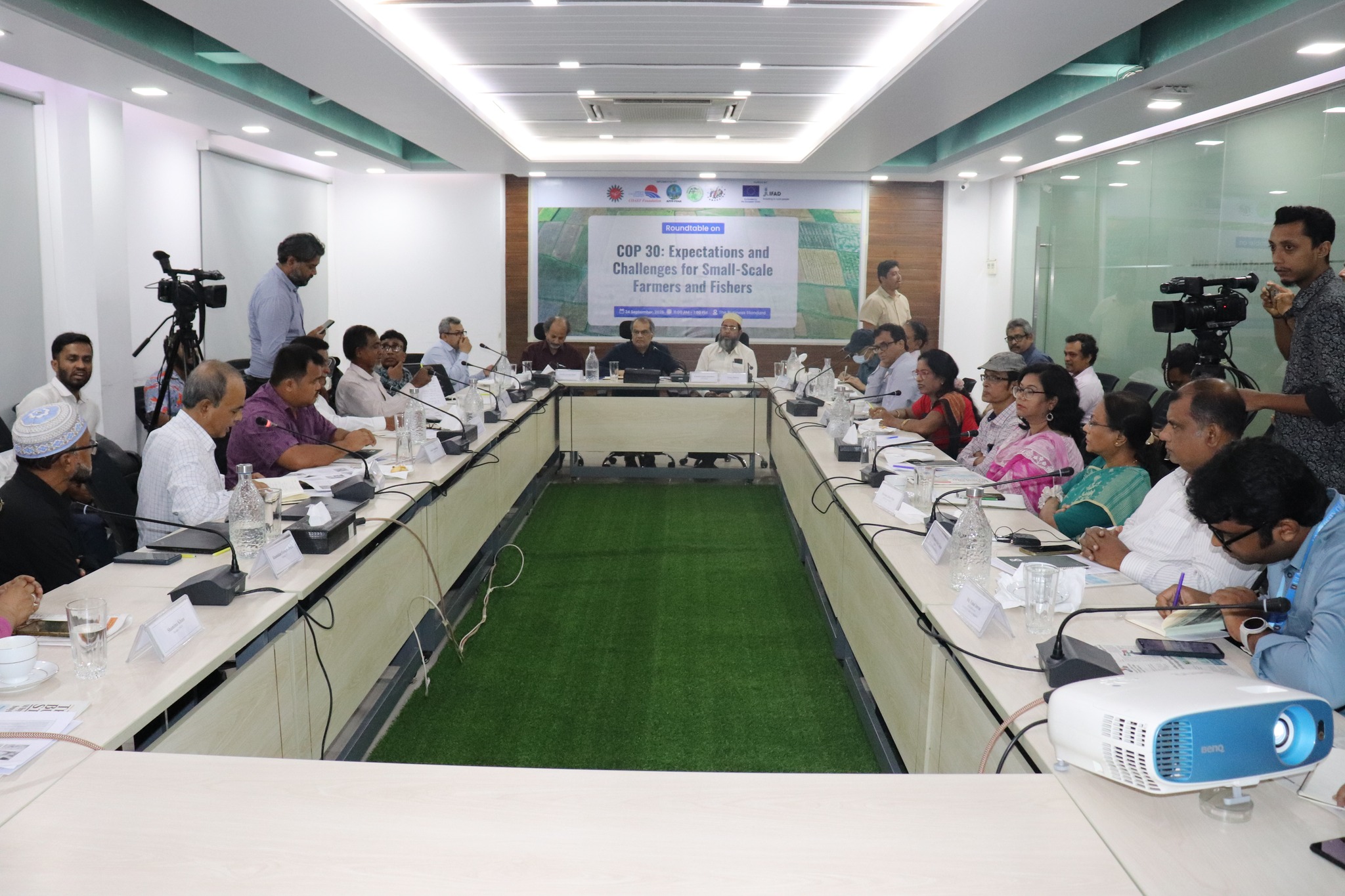
On 24 September 2025, COAST Foundation and Bangladesh Farmers Forum, with support from the APFP-FO4A program, organized a roundtable discussion titled “COP30: Expectations and Challenges for Small-scale Farmers and Fishers,” bringing together leaders from farming and fishing communities to highlight their climate-related concerns.
Speakers emphasized that the rights and roles of small-scale farmers and fishers remain largely overlooked in Bangladesh’s national climate plans, including the NDC and NAP. Despite agriculture and fisheries serving as the backbone of the country, with 40% of the population employed in these sectors and 16 million families depending on them, only 17% of farmers have access to institutional financing. This lack of financial support continues to hinder their ability to implement climate adaptation measures.
Participants put forward several key demands. They called for at least 10–15% of climate finance to be directed straight to government-recognized farmer organizations that work with small-scale farmers and fishers in remote areas. These groups, they noted, are already driving adaptation efforts on the ground, often without adequate recognition or resources. They also urged the incorporation of new indicators into the Enhanced Transparency Framework (ETF), including community seed banks, climate-resilient technologies, mangrove conservation, and post-harvest loss reduction.
Ensuring transparency and accountability in climate fund utilization, as well as guaranteeing the inclusion of women and young farmers in national climate decision-making, were also highlighted as essential steps.
Ahead of COP30, speakers appealed to the government to prioritize the voices of small-scale farmers and fishers and provide them with direct access to climate financing. As they stressed, these communities are not only food producers but also vital guardians of the country’s biodiversity and ecosystems.


The Asia-Pacific Farmers’ Program (APFP) – Farmers’ Organizations for Asia (FO4A) is implemented by the Asian Farmers’ Association for Sustainable Rural Development (AFA) and La Via Campesina (LVC), with funding from the European Union (EU) and the International Fund for Agricultural Development (IFAD). The program aims to strengthen the capacities of farmers’ organizations to provide economic services, advocate for enabling policies, and promote sustainable livelihoods for small-scale family farmers across Asia. APFP-FO4A is implemented in Bangladesh by the COAST Foundation.
Comments are closed