
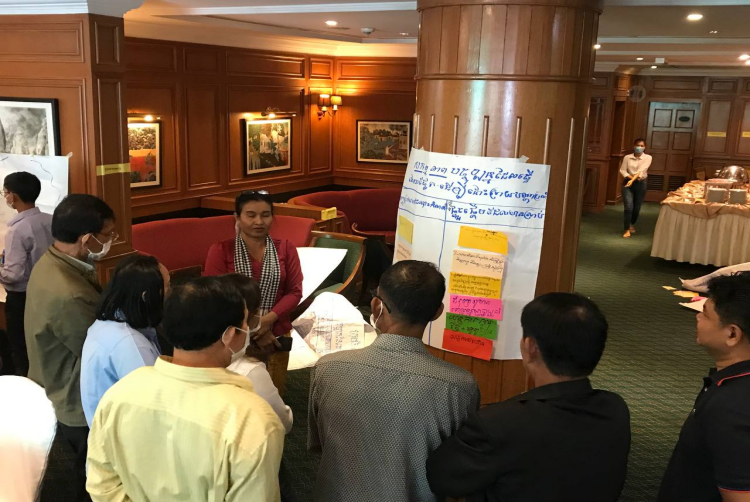
Agriculture is the backbone of Cambodia’s economy, employing approximately 75% of the population. Women play a central role in this sector, accounting for nearly 80% of the agricultural workforce, particularly in farm management and animal husbandry. This strong presence of women in agriculture is reflected at the community level through women-led cooperatives such as the Cheab Samtipheap Satrey Klahan Agricultural Cooperative.
The Cheab Samtipheap Satrey Klahan Agricultural Cooperative is located in Chiep Commune, Teuk Phos District, Kampong Chhnang Province, Central Cambodia. Of the cooperative’s 251 members, 214 are women. The cooperative’s general assembly elected Chan Sophal as president. The cooperative was officially registered with the Department of Agriculture, Forestry and Fisheries in 2012, with technical and administrative support from Life With Dignity (LWD), which assisted in the preparation of required documents and organizational requirements.
The cooperative comprises members aged 25 to 60, with only 10–15 members above 60 years old. While most members are farmers and livestock raisers, others are involved in palm sugar production, vegetable farming, and trading agricultural inputs. Most female members are engaged in agricultural activities such as palm sugar production, the sale and purchase of agricultural fertilizers, livestock raising, and vegetable cultivation.
The main goal of the Cheab Samtipheap Satrey Klahan Agricultural Cooperative is to ensure stable livelihoods, fair living standards, and reliable market access for its members. By organizing farmers into production groups, improving farming practices, and linking products to supermarkets, the cooperative aims to increase members’ income and strengthen their bargaining power in the market.
Since its formation, the cooperative has received technical and financial support from various stakeholders, including LWD, Farmer and Nature Net Association (FNN), CamboDHRRA, Phnom Neang Karey Association, and the Provincial Department of Agriculture, Forestry and Fisheries (PDAFF). LWD and FNN provided capacity-building trainings for the cooperative’s board of directors and committees on business planning, supply chains, and gender in agriculture.
Under the APFP-FO4A program, implemented in Cambodia by FNN, the cooperative received funding support in implementing organic rice contract farming with the Cambodian Agricultural Cooperative Corporation (CACC). This initiative strengthened the cooperative’s capacity to access premium markets while enhancing members’ understanding of internal control systems, organic standards, and organic rice production. Members also received training on agricultural product packaging and labeling to improve marketability.
The Asia-Pacific Farmers’ Program (APFP) – Farmers’ Organizations for Asia (FO4A) is implemented by the Asian Farmers’ Association for Sustainable Rural Development (AFA) and La Via Campesina (LVC), with funding from the European Union (EU) and the International Fund for Agricultural Development (IFAD). The program aims to strengthen the capacities of farmers’ organizations to provide economic services, advocate for enabling policies, and promote sustainable livelihoods for small-scale family farmers across Asia.
Additional support from PDAFF Kampong Chhnang and the Phnom Neang Kangri Association further strengthened the capacity of local committees through training in management, business planning, and financial management, as well as technical skills in crop production and animal husbandry.
FNN trained two groups of women farmers in standard production methods, organic vegetable production, and vegetable packaging for supermarket sales. In addition, women members participated in gender-related trainings, improved agricultural practices (vegetable growing, animal husbandry, and organic farming), and digital marketing initiatives facilitated by PDAFF and LWD.
Women from the cooperative also became members of the Peaceful Chiep Agricultural Community of Brave Women, an initiative focused on selling agricultural products online. These activities supported farmers’ transition from traditional farming practices to modern and market-oriented approaches, particularly through digital marketing, which has enabled members to independently promote and sell their products.
Women’s active involvement in farming has contributed to food security by supplying safe and organic food to both domestic and international markets. The cooperative collectively markets vegetables, palm sugar, eggs, poultry, and organic rice through local traders and brokers, as well as regional markets and urban outlets in Phnom Penh, including KOC Supermarket and the organic rice exporter CACC/Amru Rice.
Annually, the cooperative sells approximately 20 tons of organic rice, 2 tons of palm sugar, 1–1.5 tons of vegetables, and over 1 ton of chicken. While the community aims to expand production to 200–300 tons of rice per year and 200–300 kg of vegetables per day, current supply levels remain below market demand.
Despite these limitations, positive income changes are evident. Around 50% of members now earn between KHR 300,000 and 400,000 (USD 75-100) per month, compared to having little or no income previously. The cooperative’s long-term income target is for each member to earn 1–1.5 million riels per month.
Project support has generated long-term positive impacts for members of the Cheab Samtipheap Satrey Klahan Agricultural Cooperative. Through technical training, learning exchanges, and access to improved inputs such as net houses and organic fertilizers, members have significantly increased their production yields, particularly for organic rice, vegetables, and poultry, and improved their access to fair and stable markets.
The adoption of organic farming practices has reduced environmental pollution, enhanced soil fertility, and increased biodiversity, while providing safe and healthy food for consumers. At the same time, the cooperative has created employment opportunities for its members by involving them directly in cooperative-led business activities.
The cooperative’s achievements demonstrate the strong leadership capacity of women committee members, who actively mentor and support other community members in establishing agricultural enterprises such as poultry and vegetable farming. As a result, more cooperative members are now sustainably engaged in agriculture and earning a stable income, contributing to improved livelihoods and community resilience.
Limited working capital remains a major challenge for the cooperative, as it restricts its ability to purchase sufficient rice from members and compete with brokers, thereby affecting its capacity to meet contracted supply volumes. Unlike brokers who offer immediate cash payments, the cooperative can only pay farmers after the rice has been sold, creating difficulties for members who require urgent income. In addition, low-interest loan services have been discontinued due to ongoing cash shortages and the termination of seed grant support, which has further weakened the capacity of the Credit Committee. As a result, some members who previously accessed loans made poor financial decisions, leading to indebtedness, increased vulnerability, and, in some cases, migration.
Based on these experiences, the cooperative decided to stop extending credit to delinquent members. Instead, remaining funds were redirected toward strengthening cooperative-managed businesses such as rice trading, poultry, and vegetable production. This approach has allowed the cooperative to better align production with market demand and increase members’ income in a more sustainable manner.
Comments are closed