
The Baphnom Meanchey Agricultural Cooperative (BMAC) was established in 2010 through the EU-funded Komrong Daiko project implemented by AVSF. The cooperative evolved from the Village Animal Health Workers’ Association, which had been operating since 1993. From the beginning, its objectives have included providing animal health services, selling veterinary medicines and agricultural inputs, building members’ technical capacity, and increasing household income through agricultural production.
BMAC is based in Rong Damrei village, Cheung Phnom commune, Baphnom district, and was officially registered by the Provincial Department of Agriculture, Forestry and Fisheries (PDAFF) in Prey Veng province under certificate No. 006 AC on May 4, 2010. At its founding, the cooperative had 56 members (25 women) from 25 villages in 9 communes, with 75 shares valued at KHR 40,000 per share, equivalent to KHR 3 million (USD 750). By 2025, membership had expanded to 252 (87 women), with 3,987 shares and a total capital of KHR 159,480,000 (approximately USD 39,870).
Since its establishment, BMAC’s income-generating activities have centered on supplying and selling veterinary medicines and vaccines, cattle sharing, and fertilizer trading. In 2016, the cooperative broadened its operations by entering the rice seed trading business, enabling members to produce high-quality rice seed for national markets. This expansion was supported by the Rice Seed Production and Promotion (RSPP) and Boosting Food Production (BFP) projects implemented by MAFF/PDAFF, with additional assistance from JICA.
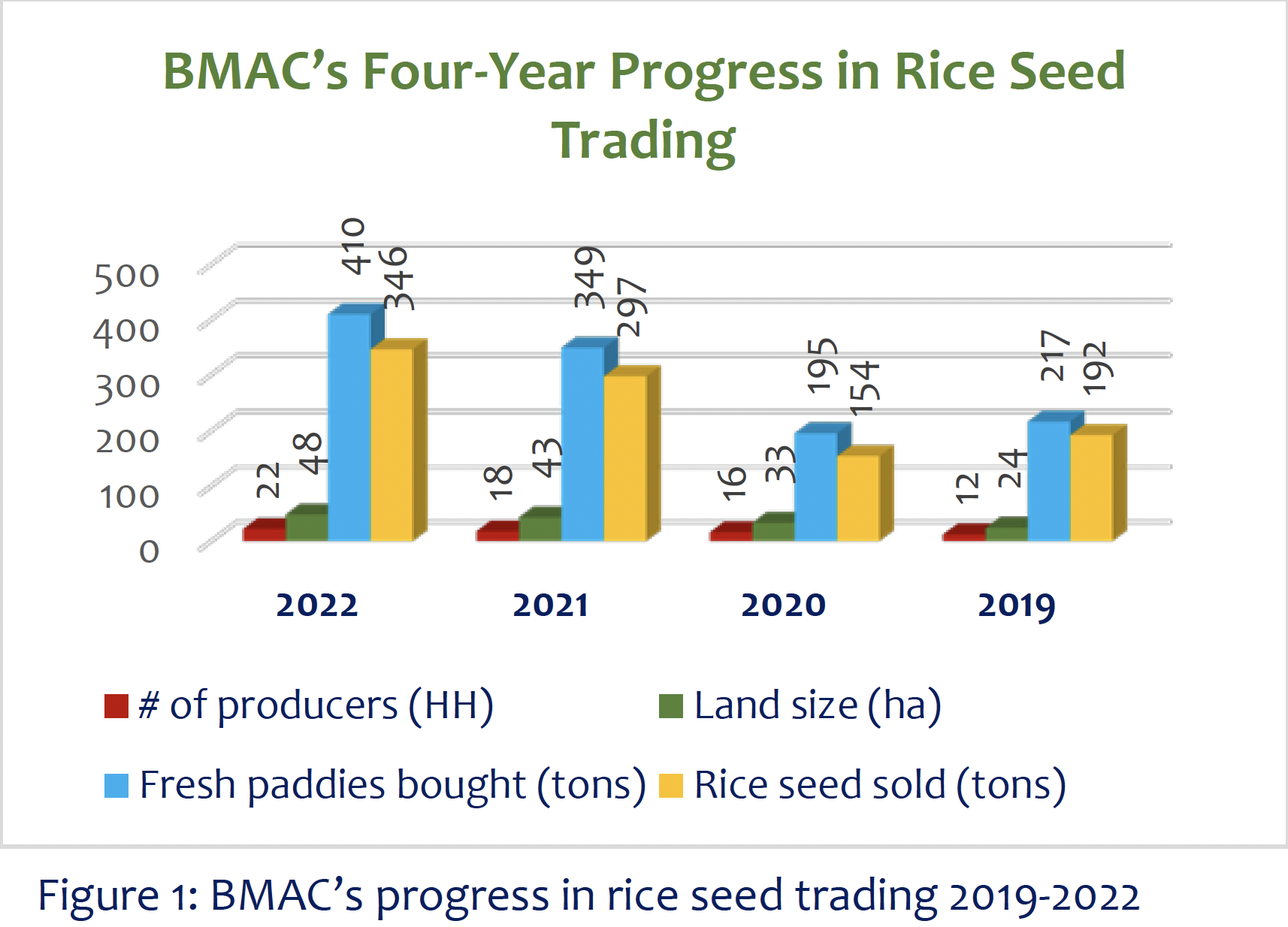
The rice seed initiative began with 10 producers cultivating 15 hectares, resulting in 90 tons of QDS-certified varieties: Phka Romduol, Sen Kra Ob, OM5451, and IR504. By 2022, production had grown significantly—22 producers were cultivating 48 hectares and producing over 346 tons of rice seed, compared to 192 tons in 2019 from 12 producers on 24 hectares.
As BMAC’s four main income-generating activities expanded, the need for stronger human resource management, financial systems, and marketing strategies became increasingly urgent. However, the cooperative continued to use traditional management approaches and lacked a formal business plan. This resulted in persistent challenges such as limited financial capital, unclear annual activity planning, and weak coordination across operations.
To address these gaps, the APFP-FO4A program, which is implemented in Cambodia by FCFD, FNN, FAEC, FWN, CFAP, and FAEC-Cambodia, provided training for BMAC leaders on business plan development and bookkeeping. With the support from APFP-FO4A, BMAC created a three-year business plan for 2023–2025, outlining annual working capital needs of USD 188,251 in 2023, USD 218,524 in 2024, and USD 259,875 in 2025.
To support its cash flow, BMAC received four rounds of zero-interest revolving funds from the ARISE program: USD 30,000 in both 2021 and 2022, USD 15,000 in 2023, and USD 20,000 in 2024. The cooperative also received USD 9,250 from the APFP-FO4A to support further business expansion from 2023 to 2025. Using its strengthened business plan, BMAC secured loans of USD 62,000 from the Agricultural and Rural Development Bank (ARDB) and USD 70,000 from Chamroeun Microfinance Institution, accessing a total of USD 104,520 in financial support by mid-2025 while maintaining timely repayments.
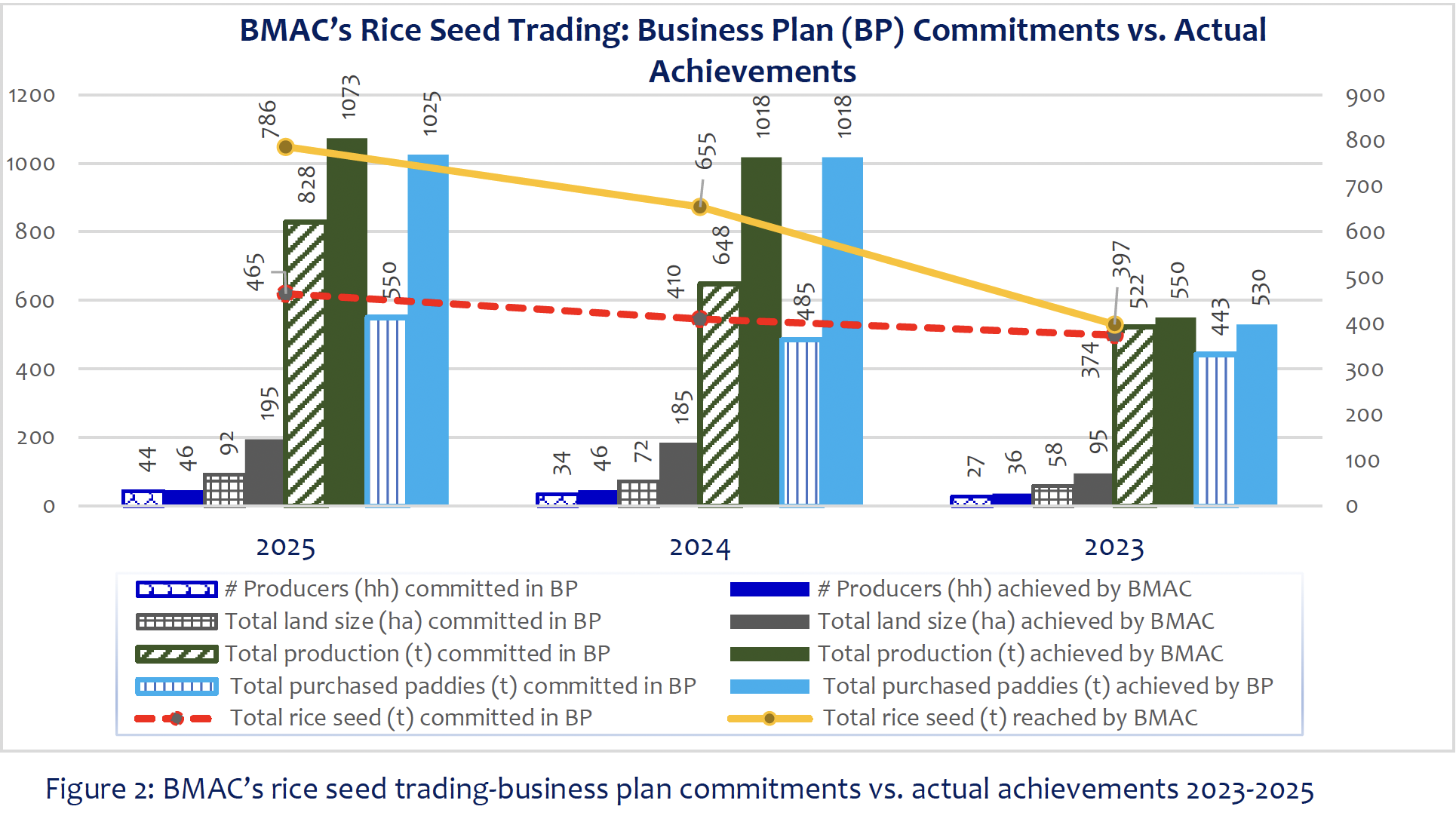
With clear guidance from its business plan, BMAC’s rice seed trading operations surpassed expectations. In 2023, the plan targeted 27 rice producer households but achieved 36; in 2024, the target was 34 but reached 46. Rice seed production also exceeded goals: 374 tons planned and 397 tons achieved in 2023, and 410 tons planned versus 655 tons produced in 2024.
The business plan has significantly strengthened BMAC’s institutional capacity, technical skills, and overall performance. Membership increased from 197 in 2023 to 252 in 2025. Share capital nearly doubled: from 1,918 shares (USD 19,180) in 2022 to 3,987 shares (USD 39,870) in 2025.
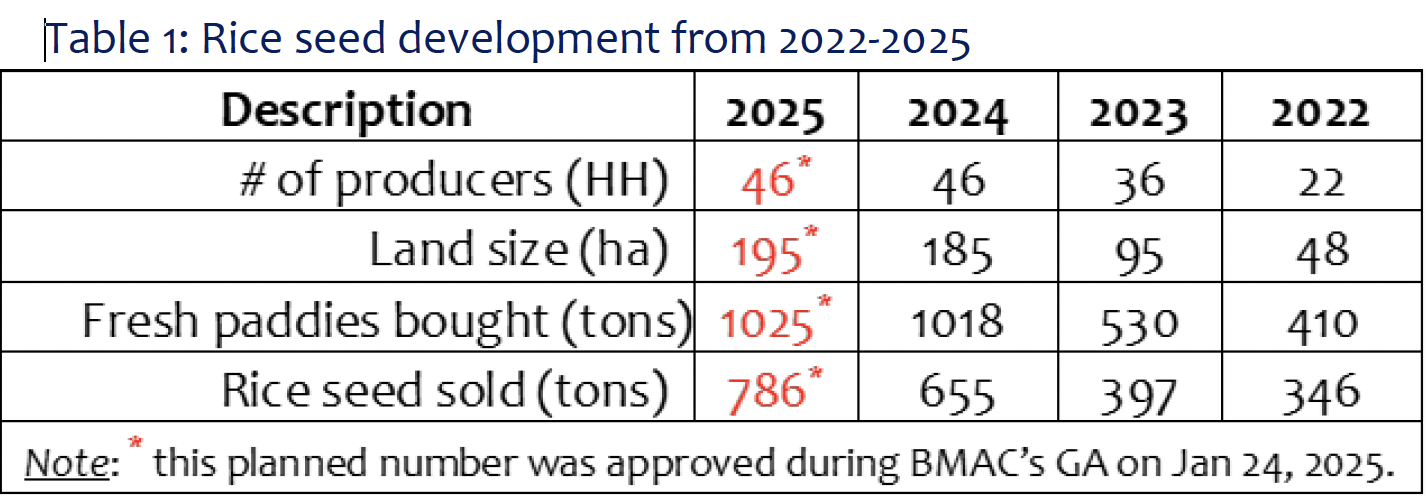
Net profits also grew consistently, reaching USD 13,704 in 2023 and USD 18,416 in 2024, compared to only USD 8,732 in 2022, before the development of the business plan. The rice seed enterprise experienced particularly strong growth: the number of producers rose from 22 in 2022 to 36 in 2023 and 46 in 2024, while land area expanded from 48 hectares in 2022 to 185 hectares in 2024. Over the same period, rice seed volume increased from 346 tons to 655 tons.
To sustain this progress, the “Youth and Smart Agriculture” project, implemented by AVSF and FCFD in 2024, supported BMAC in enhancing rice seed quality. This included introducing agroecological techniques, rice transplanting machinery, and opportunities for youth employment. Through this project, BMAC received a full-time staff member for two years, essential office equipment (computer, projector, printer), a 2.5-ton truck, and tools and materials for rice transplanter services available to members and non-members.
Over the two years of business plan implementation, BMAC has made significant improvements in organizational development, business management capacity, coordination, marketing, and advocacy. Membership, production, and profits have all increased steadily.
However, challenges remain across the rice seed value chain, from production to markets. These include issues in quality control, paddy processing, stock management, market instability, and ongoing cash flow limitations. Nonetheless, the cooperative’s leadership has demonstrated strong commitment and effective management.
Looking ahead, BMAC President Mr. Khun Saeom expressed optimism: “We hope BMAC will become a leading cooperative in Cambodia for high-quality rice seed production and supply in the future.” He emphasized the cooperative’s dedication to contributing to local development by improving rice quality for domestic and export markets, creating employment, and enhancing the livelihoods of farmers in the community.
The Asia-Pacific Farmers’ Program (APFP)–Farmers Organizations for Asia (FO4A) is implemented by the Asian Farmers’ Association for Sustainable Rural Development (AFA) and La Via Campesina (LVC), with funding from the European Union (EU) and the International Fund for Agricultural Development (IFAD). The program aims to strengthen the capacities of farmers’ organizations to provide economic services, advocate for enabling policies, and promote sustainable livelihoods for small-scale family farmers across Asia.
The Assuring Resiliency of Family Farmers (ARISE) program was first launched in response to the COVID-19 pandemic, aiming to empower farmers’ groups to meet their members’ needs and ensure food security during the crisis. The succeeding phase of the program continues its mission to help family farmers become more resilient and self-reliant. It focuses on strengthening the capacities of farmers’ organizations (FOs) to manage production support for their members while expanding partnerships with governments, private sector actors, and financial institutions. Through this approach, ARISE addresses the persistent financing gap and helps smallholder farmers gain better access to markets. ARISE is implemented by the Asian Farmers’ Association for Sustainable Rural Development (AFA) and is funded by the International Fund for Agricultural Development (IFAD).

Comments are closed