
Pursat, Cambodia – In Veal Veng district, Pursat province, Cambodia, Nop Kolap once struggled to make ends meet. Her family of five depended on irregular farm labor. She used to be employed to harvest potatoes and maize for KHR 20,000 (USD 5) a day. Her husband’s job as a pepper harvester brought in about KHR 600,000 (USD 150) a month. Even when combined, their income is barely enough to cover food, gas, medicine, and their children’s education. When the planting or harvesting seasons ended, so did their income.
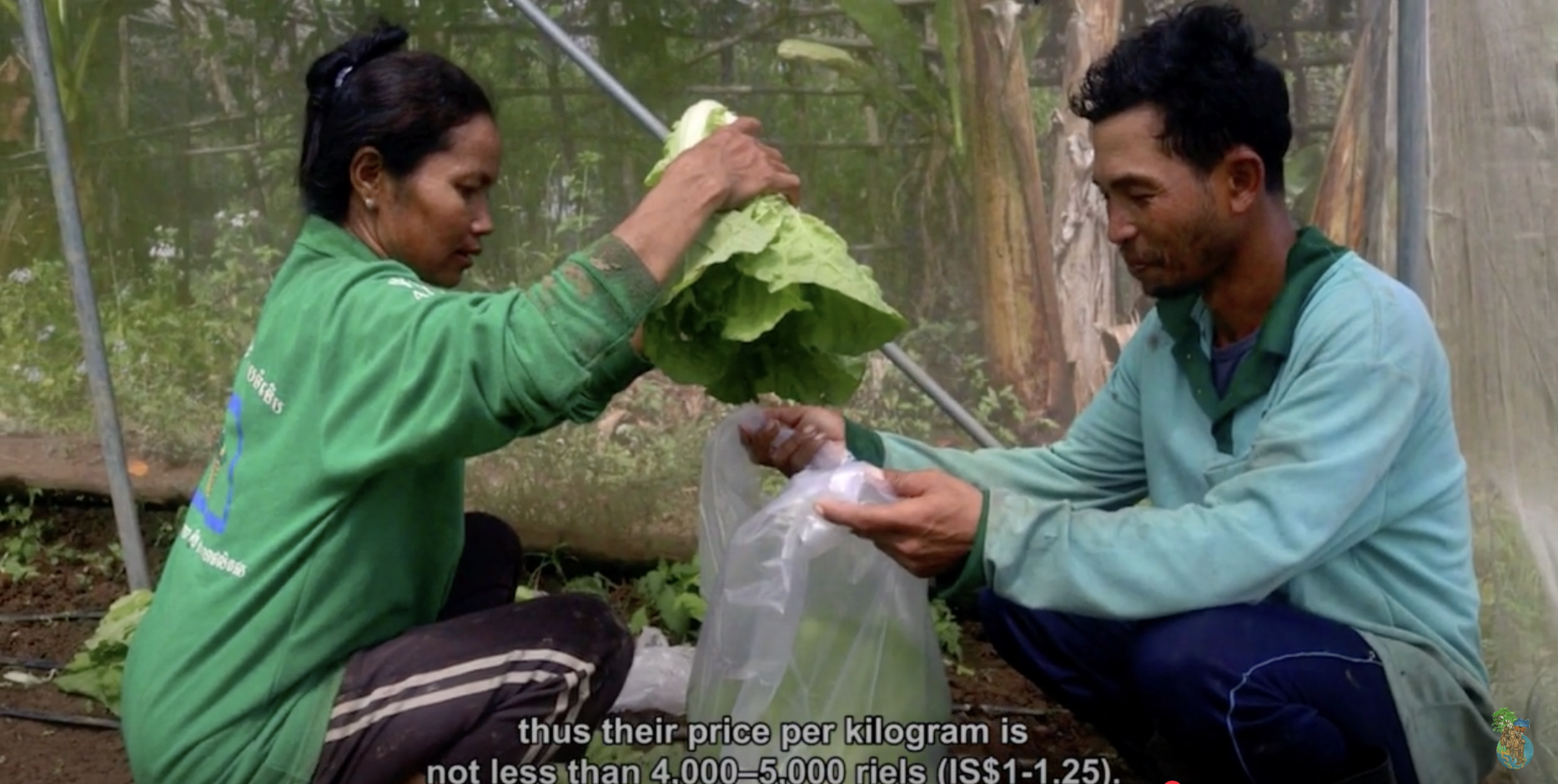
Everything began to change when the Farmer and Nature Net Association (FNN) reached out to her under the APFP–FO4A program, which supports smallholder farmers to strengthen their enterprises and livelihoods. FNN encouraged Kolap to grow vegetables while raising chickens, providing her with initial support of KHR 600,000 (USD 150) to start planting vegetables. She also used some of the money to built a fence to keep the chickens away from the crops.
However, the lack of nearby water remained a challenge. The Aphiwath Promouy Marich Agricultural Cooperative, of which Nop Kolap is a member, stepped in to help. They provided her with loans to dig a well, install solar-powered irrigation, and build a net house for vegetable production.
The results were transformative. Nop Kolap’s first cucumber harvest earned her USD 1,500 a month, which allowed her to pay debts, improve her home, and reinvest in her farm. She also began growing more vegetables including tomatoes, broccoli, and cabbage.
Today, she earns between KHR 100,000 to 200,000 (USD 25–50) a day from selling vegetables such as cucumbers, garlic leaves, luffa, wax gourds, and round eggplants. With her growing income, she was able to buy 1.5 hectares of land, built a new house, and installed a biogas system for cooking.
“My livelihood has gone up a level because of the agricultural cooperative’s help,” she says. “When I am down, there is no other help but from them.”
Her success has inspired 25 other families in her community to follow her lead in vegetable production.
Looking ahead, Kolap hopes to expand her net houses and increase her vegetable yield. Her message to fellow Cambodians is simple but powerful:
“We don’t need to go abroad to find work. Cambodia is rich in farmland. We can build our future right here.”
The APFP-FO4A program is implemented by the Asian Farmers’ Association for Sustainable Rural Development (AFA) and La Via Campesina (LVC), with funding support from the European Union (EU) and the International Fund for Agricultural Development (IFAD). The program aims to strengthen the capacities of farmers’ organizations to provide economic services, advocate for enabling policies, and promote sustainable livelihoods for small-scale family farmers across Asia.
Comments are closed