
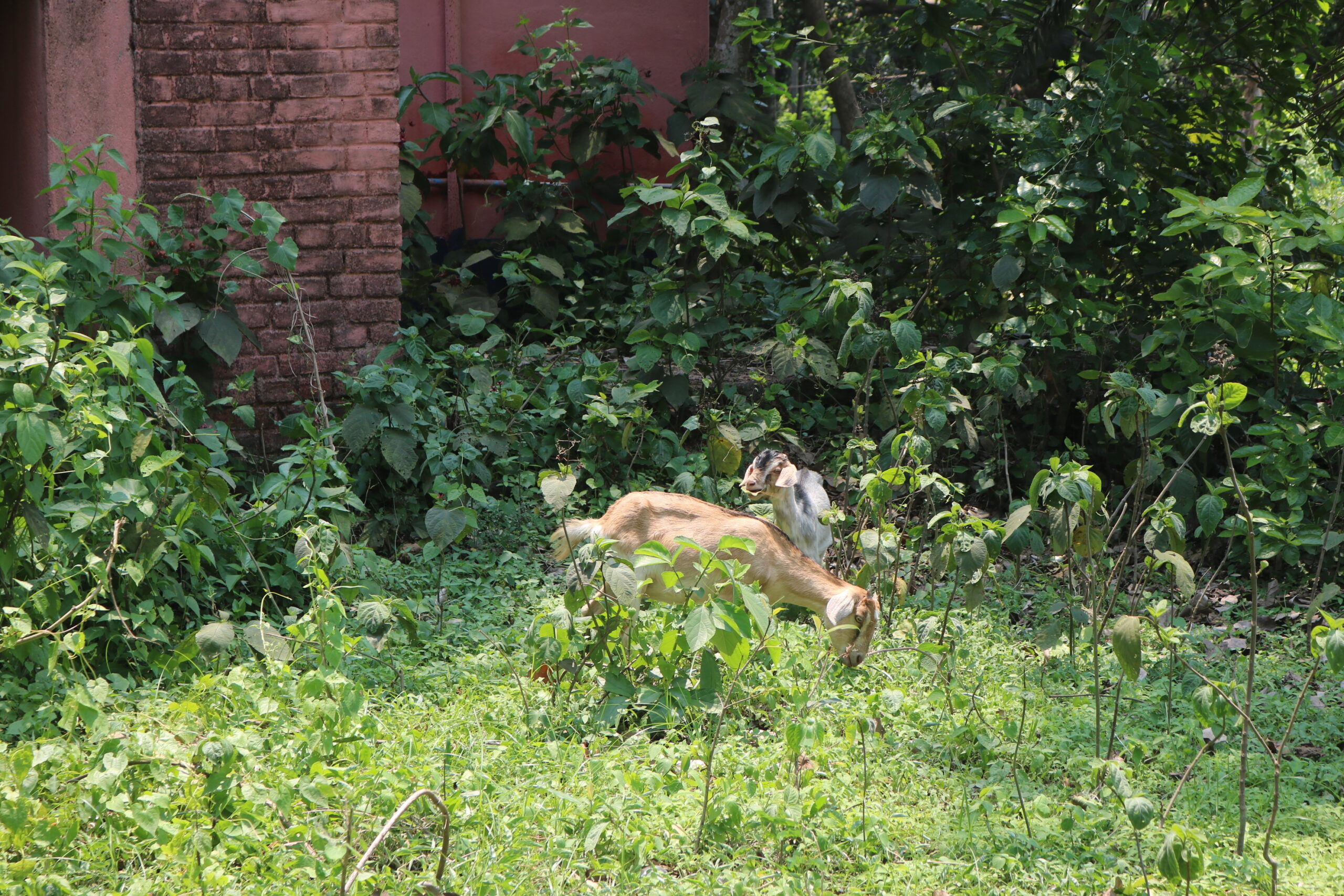
West Bengal, India – In March 2024, the Institute for Motivating Self Employment (IMSE), an implementing partner farmers’ organization in West Bengal, launched a goat farming initiative to improve the livelihoods of rural women farmers. Supported by a USD 50,000 grant from the APFP-FO4A program, the initiative has enhanced income opportunities and livelihoods for women engaged in goat rearing in Moldanga village, West Bengal, India.
Before joining the program, women typically kept only one or two goats, supplementing their income with other work such as stitching and embroidery. Through the grant, each was able to purchase five to six goats, sourced from government-registered farms. Within a year, many doubled their stock to ten goats. Out of these, they could sell four to repay their loan to IMSE and use the remaining goats to continue breeding or expand their herd.
The program follows a revolving fund model, with loans provided at a minimal 1% interest rate. Repayments are made twice a month via bank transfer and recorded in passbooks. The loan amounts vary depending on each member’s requirements. All the initial loans have already been repaid in full, with many women reinvesting their profits into more livestock or diversifying into other businesses.
Participation starts with capacity-building training and an application for financial support. “We’ve known about IMSE for quite a while now,” says farmer Naju Bibi. “When we need support, we contact IMSE, join the training, and then apply for the grant. With this, we scale up our livelihood.”
The impact has been significant. Women report improved food security, the ability to send their children to school, build or improve houses, and even invest in gold for their children’s marriages.


Individual success stories
- Muksuda Bibi started with five goats, which grew to 12. She sold seven goats for INR 29,000 and used the money for her son’s education, a bicycle for school, books, tuition fees, and some gold. She loaned INR 30,000 from the grant and INR 40,000 from the revolving fund, repaying the full amount within one year.
- Sabina Bibi began with five goats, increased her herd to ten, sold four goats, and fully repaid her loan.
- Mobina Bibi had no income before joining the project. Now, through goat farming, she has been able to fund the construction of her house.
- Another member started with six goats, sold them, and purchased a cow. Today she owns four cows valued at INR 60,000—double her initial investment of INR 30,000—and has already repaid her loan.
- Rabia Bibi started with four goats, and now owns six goats and two cows.
- One young woman farmer joined the program while awaiting a government job, using goat rearing to support herself in the meantime.


The project has also sparked a ripple effect. When one woman successfully scaled up their business, others took notice and applied for IMSE’s grant. Membership in the goat-rearing group grew from 10 to 45 women. Alongside livestock production, the program has raised awareness about livelihood opportunities, government schemes, and education.
Some women have diversified their income sources, combining goat rearing with other activities like craftwork, market selling, running small shops, stitching, or making local cigarettes. The group even visited Kolkata for a learning exchange and seminar to strengthen their skills.
For most households, goat rearing is done by women, while husbands work as tuktuk drivers, masons, construction laborers, hawkers, or shopkeepers. This arrangement allows women to manage and grow their livestock business alongside their domestic responsibilities.
The success of the first phase has been so strong that all 160 women have applied for a second loan cycle. For them, goat farming is more than a business—it’s a path to financial independence, better living conditions, and greater community solidarity in rural West Bengal.
The Asia-Pacific Farmers’ Program (APFP) – Farmers’ Organizations for Asia (FO4A) is implemented by the Asian Farmers’ Association for Sustainable Rural Development (AFA) and La Via Campesina (LVC), with funding from the European Union (EU) and the International Fund for Agricultural Development (IFAD). The program aims to strengthen the capacities of farmers’ organizations to provide economic services, advocate for enabling policies, and promote sustainable livelihoods for small-scale family farmers across Asia.
Comments are closed