
Gujarat, India – Meenaben Khokhar is a woman farmer from Mata na Math village in Kutch district, Gujarat, India. She completed her education up to Grade 10 and has been engaged in farming for over 25 years. Her family owns four acres of agricultural land, and farming has traditionally been their primary source of livelihood.
Despite years of hard work, Meenaben’s household struggled with unstable income, rising debts, and high production costs. Conventional farming practices relied heavily on chemical fertilizers such as DAP and urea, costing the family approximately INR 10,000–12,000 (USD 110–133) per acre. These inputs degraded soil health, posed health risks, and placed a heavy financial burden on the household. At the time, Meenaben had limited exposure beyond her village, low confidence, and little awareness of alternative livelihood opportunities.
A turning point came nine years ago when Meenaben joined the Self Employed Women’s Association (SEWA). Through SEWA, Meenaben became part of a Farmers’ Organization supported under the APFP–FO4A program.
The Asia-Pacific Farmers’ Program (APFP) – Farmers’ Organizations for Asia (FO4A) is implemented by the Asian Farmers’ Association for Sustainable Rural Development (AFA) and La Via Campesina (LVC), with funding from the European Union (EU) and the International Fund for Agricultural Development (IFAD). The program aims to strengthen the capacities of farmers’ organizations to provide economic services, advocate for enabling policies, and promote sustainable livelihoods for small-scale family farmers across Asia.
The programme provided structured capacity building, practical training, and access to financial and institutional support that enabled Meenaben to strengthen and diversify her livelihood. Through the intervention, she received hands-on training in organic farming, including the preparation of home-made organic inputs such as jeevamrut, compost, and natural pest control methods. The programme also supported livelihood diversification, with a strong focus on animal husbandry and dairy as complementary income sources to agriculture. Specialized training on animal health and productivity equipped her with knowledge on proper feeding practices, vaccination schedules, seasonal care, and techniques to improve milk quality. In addition, financial literacy and digital inclusion training enabled her to confidently use mobile phones for payments, savings, and loans. Access to small loans further allowed her to invest in livestock and expand her dairy enterprise, while strengthened market linkages ensured reliable outlets for organic produce, milk, and desi cow ghee, contributing to sustainable and profitable income generation.
With SEWA’s guidance, Meenaben convinced her family to shift to 100% organic farming, cultivating groundnut and paddy using only home-made organic inputs. This transition eliminated chemical fertilizer costs, reducing expenses of INR 10,000–12,000 (USD 110–133) per acre to zero. Soil health improved, and organic produce fetched better prices in local markets.
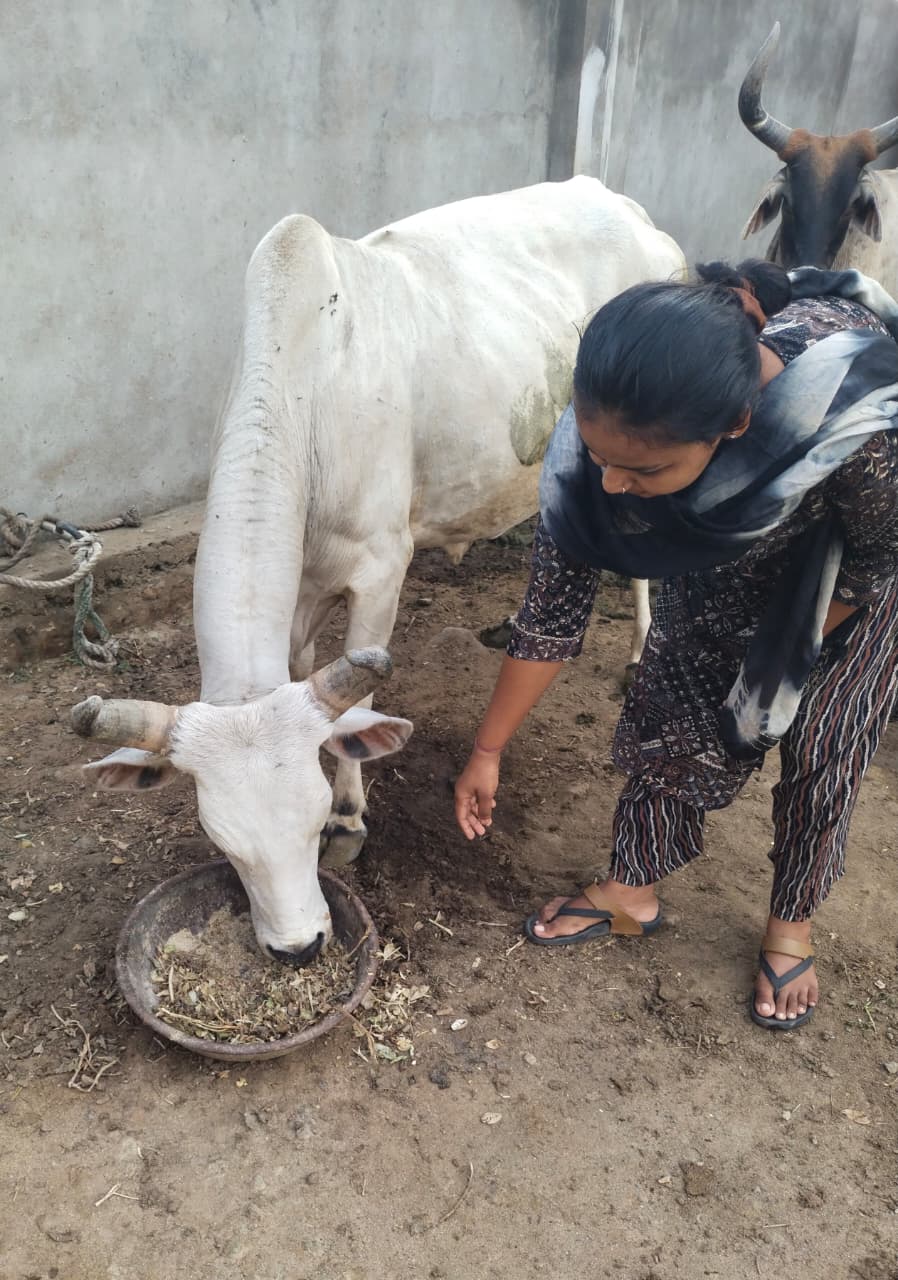
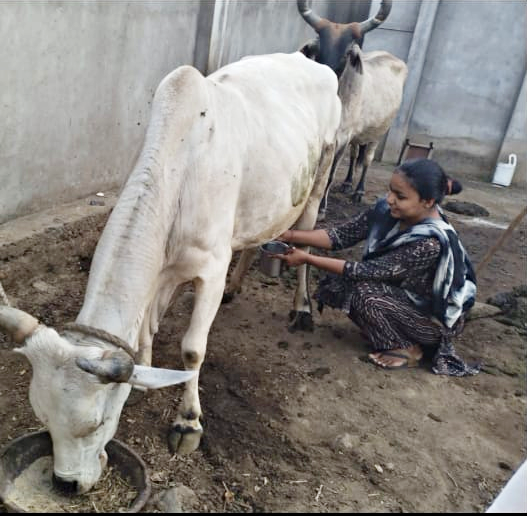
Furthermore, SEWA encouraged Meenaben to develop a secondary income source through dairy farming. She started with one cow and gradually expanded to four cows using her earnings and SEWA-facilitated credit. She now sells milk to a nearby dairy and produces pure desi cow ghee, which has strong market demand. Training in animal health and management significantly increased productivity. Meenaben’s monthly income from animal husbandry rose from INR 10,000–12,000 to INR 15,000–16,000 (USD 166–177), representing an income increase of nearly 30% from dairy alone.
Before joining the programme, Meenaben’s total household income was approximately INR 20,000–25,000 (USD 221–277) per month. After adopting organic farming, diversifying into dairy, and strengthening market access, her monthly income increased to INR 40,000–45,000 (USD 443–498), an increase of nearly 50%.
Chemical fertilizer and pesticide expenses amounting to INR 10,000–12,000 per acre were eliminated after the transition to organic farming. By producing organic inputs at home using natural methods, the household no longer incurred any monetary costs for fertilizers or pesticides, resulting in significant savings and improved financial stability.
Beyond economic gains, Meenaben experienced a significant transformation in confidence and leadership. Financial literacy training enabled her to independently manage income, savings, loans, and digital payments. She now actively teaches other women in her village about financial management, organic farming, and livelihood diversification.
Reflecting on her journey, Meenaben shares, “I was not highly educated, but today I can speak and understand more than many educated people. Thanks to SEWA, AFA-LVC, IFAD, and the EU for the training and empowerment that gave me the confidence to speak, the courage to lead, and the purpose to move forward.”
Meenaben Khokhar’s experience highlights several effective innovations and good practices in promoting women’s empowerment and sustainable rural livelihoods. A key innovation was the complete transition to organic farming using home-made inputs such as jeevamrut and compost. This approach eliminated dependence on costly chemical fertilizers, significantly reduced production expenses, improved soil health, and increased the market value of agricultural produce. Another important good practice was livelihood diversification through animal husbandry, which complemented crop production and provided a stable secondary income from milk and desi cow ghee. SEWA’s integrated training model for women—covering organic agriculture, animal health, financial literacy, and digital payments—enabled Meenaben to manage multiple income streams independently. Access to small-scale finance supported productive investment in livestock, while strengthened market linkages ensured that her organic produce and dairy products generated sustainable and profitable returns. Peer learning and community networks fostered confidence among women and encouraged the adoption of new practices. Together, these practices demonstrate a holistic and replicable model for women-led rural enterprise development.
Several factors facilitated the success of Meenaben’s livelihood transformation. Foremost was SEWA’s supportive institutional framework, particularly through the APFP–FO4A programme, which provided structured training, continuous mentoring, and organizational support through the Farmers’ Organization. Capacity-building initiatives equipped Meenaben with practical skills in organic input preparation, animal health management, and income diversification, allowing her to reduce costs and improve productivity. Access to financial services, including small loans and financial literacy training, enabled her to invest confidently in livestock and manage savings, loans, and digital transactions. Community and social networks within SEWA and the Farmers’ Organization played a critical role by fostering peer learning, confidence-building, and knowledge exchange. Additionally, access to local markets for organic produce, milk, and desi cow ghee ensured that income gains were both viable and sustainable.
Despite the positive outcomes, Meenaben faced several challenges along her journey. Prior to SEWA’s intervention, financial constraints, high input costs, and accumulated debt limited her ability to experiment with new farming practices or invest in alternative livelihoods. Even after accessing loans, managing cash flow across multiple income sources required careful planning and discipline. Market-related challenges also persisted, particularly the need to ensure consistent demand for organic products and dairy items. Limited local infrastructure, storage facilities, and market access posed potential barriers to scaling production. However, continued mentoring, training, and peer support helped Meenaben navigate these constraints and gradually strengthen her enterprise.
Meenaben’s story demonstrates that sustainable rural development is most effective when women at the grassroots level are economically empowered, socially respected, and supported through collective action. The case shows that reducing input costs through organic practices can significantly improve household incomes while protecting health and the environment. It also highlights the importance of livelihood diversification in building resilience against agricultural risks. Equally important is the role of integrated capacity building that combines technical skills, financial literacy, and confidence-building. Meenaben’s transformation from a shy farmer into a confident earner and mentor underscores how institutional support and community networks can unlock women’s leadership potential and create lasting change.
Recommendations emphasize that development programmes should adopt integrated livelihood approaches that combine agriculture with allied activities such as animal husbandry to enhance income stability for rural women. Continuous investment in capacity building—particularly in organic farming, animal care, financial literacy, and market awareness—is crucial to help women adopt and sustain new practices. Access to affordable and flexible financial services, supported by practical financial education, should be strengthened to enable enterprise expansion. Efforts to improve market linkages, including support for branding, value addition, and cooperative marketing, can further increase returns for women-led enterprises. Policymakers and development partners should recognize and incentivize women farmers through targeted schemes and training programmes. Finally, successful models like Meenaben’s should be systematically documented and replicated to inform future interventions and scale women’s economic empowerment across similar rural contexts.
Comments are closed