
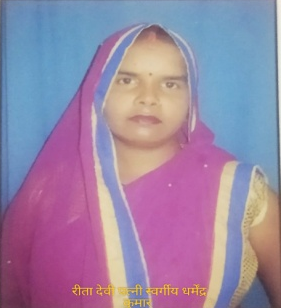
Uttar Pradesh, India – In the village of Bhairampur, under Mohanlalganj block of Lucknow district, in Uttar Pradesh, India lives Reeta Devi, a farmer and housewife whose life took a difficult turn a few years ago when she lost her husband, Dharmendra Kumar. Left to raise three children (two daughters and a son) on her own, Reeta faced the task of providing for her family while managing her household responsibilities.
At first, Reeta took up small jobs wherever she could find them, but the income was never enough to meet the growing needs of her family. Determined to build a more stable livelihood, she turned to farming on her small piece of land, less than two acres. She began with paddy and wheat, but the returns were disappointing. Realizing she needed a new approach, Reeta decided to diversify her crops, experimenting with green vegetables and pulses like tur and mung. However, the lack of resources for fertilizers, seeds, and other inputs remained a constant struggle.
It was during this time that Reeta attended a SEWA (Self Employed Women’s Association) meeting in her village. The SEWA aagewan (community leader) encouraged her to explore organic farming and adopt practices aligned with natural crop cycles. Through SEWA, Reeta received training in organic farming, vermi-composting, preparing organic manure, and climate-resilient agricultural practices.
With guidance and support, Reeta began putting her learning into practice. She used cow dung from her cattle to create vermi-compost, collected neem stems and fruits to make organic pesticides, and gradually shifted her farm toward sustainable methods. She also became an active member of the local Farmer Producer Organization (FPO), which opened new opportunities for knowledge sharing and collective growth.
Inspired by Reeta’s progress, other women farmers in the village also began to take interest. Reeta shared her experience with them and also encouraged her fellow women farmers to embrace organic farming. Beyond the farm, she motivated them to adopt eco-friendly practices in daily life, reducing plastic use, switching to jute and cloth bags, and even organizing groups to make reusable bags at home. The collected plastic was sent for recycling, ensuring that their efforts also contributed to protecting the environment.
Today, Reeta has become a source of inspiration for many women farmers in her community. Her journey from hardship to self-reliance shows how knowledge, determination, and collective strength can transform lives. With the support of the Lucknow Mahila Sewa Trust, SEWA, backed by the APFP-FO4A program, Reeta has secured her family’s livelihood and is also helping create a more sustainable future for her village.
“I am grateful to SEWA for the training and support,” Reeta says, “because today I am able to manage my household expenses and provide education for my children.”
The APFP-FO4A program is implemented by the Asian Farmers’ Association for Sustainable Rural Development (AFA) and La Via Campesina (LVC), with funding support from the European Union (EU) and the International Fund for Agricultural Development (IFAD). The program aims to strengthen the capacities of farmers’ organizations to provide economic services, advocate for enabling policies, and promote sustainable livelihoods for small-scale family farmers across Asia.

Comments are closed