
Jammu and Kashmir, India – Shahnaza Riyaz comes from Sogam village in Kupwara district of Kashmir, a remote border region along the Indo–Pakistan Line of Control, nearly 140 kilometers from Srinagar. Life in this mountainous area is shaped by harsh winters, poor connectivity, and limited livelihood opportunities. Most families depend on subsistence agriculture or daily wage labor, and opportunities for women are especially constrained by geography, poverty, and deeply rooted social norms.
Shahnaza grew up in a poor household. Her father worked as a daily wage laborer on landlords’ fields, struggling to meet the needs of a family with five children—three daughters and two sons. Despite financial hardship, he ensured that all his children received basic education in government schools. Shahnaza completed her education up to the 10th standard, but economic pressures forced her to discontinue her studies.
Watching her father’s daily struggle to sustain the household deeply affected her. Determined to contribute, she made the difficult decision to step away from formal education and look for ways to support her family. Along with encouragement from a few girls in her village, she visited the Self Employed Women’s Association (SEWA) Centre in Khumriyal, where grassroots women were being trained in natural farming, value addition, and garmenting. With a longstanding interest in agriculture, Shahnaza chose to pursue farming-related skills.
Her decision was not easily accepted. In her community, women traveling outside their villages for education or training was considered inappropriate. Her father initially resisted the idea, reflecting prevailing social norms. However, Shahnaza persisted. With courage and conviction, she convinced her family and took her first step toward a new future.
A defining moment in Shahnaza’s journey came when senior SEWA women leaders from Gujarat visited her village. They spoke about women-led livelihoods in agriculture, the power of collective organization, supply chains, and the use of technology to strengthen farming practices. Their confidence, independence, and leadership left a lasting impression on Shahnaza.


Soon after, SEWA invited her to participate in an exposure visit to Gujarat. Once again, she faced hesitation from her family and community—traveling outside the state was unheard of for women like her. Through persistent dialogue and determination, she secured her family’s permission and traveled to Gujarat with a group of women from the centre.
What she witnessed there transformed her worldview. In Gujarat, women confidently managed enterprises, cooperatives, trades, and grassroots institutions. Many shared stories of overcoming restrictions similar to those Shahnaza faced. Some had even traveled internationally to showcase their skills. The warmth and solidarity she experienced strengthened her resolve. She returned home with clarity and confidence—if they could break barriers, so could she.
Her return, however, was met with resistance. Community members criticized her and spread false accusations, questioning her character for stepping outside traditional boundaries. The pressure was overwhelming, and she broke down. At that critical moment, her mother stood by her and explained everything to her father. He listened, trusted her, and reassured her with words that became a turning point in her life: “You are free to go wherever you want.” That affirmation became a lifelong source of strength.
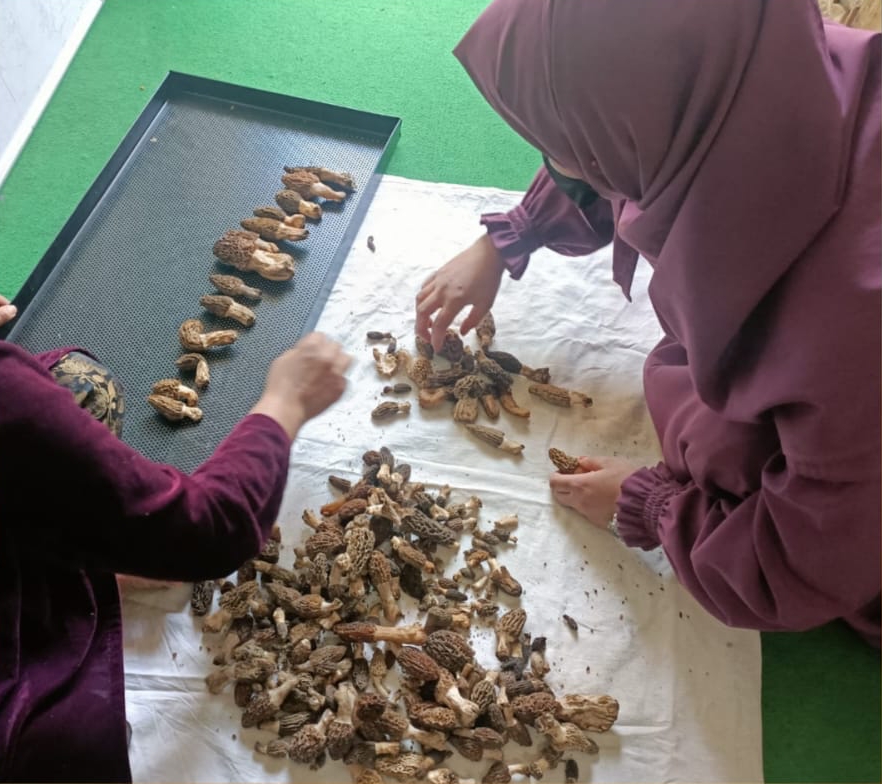
With support and guidance from the SEWA–Shehjar Community Resource Centre, Shahnaza received training in regenerative farming, composting, and value addition. She learned to use a solar dehydrator to process morels and apples into dried products, extending their shelf life from just 10 days to nearly six months. These activities were supported by the APFP-FO4A program.
The Asia-Pacific Farmers’ Program (APFP) – Farmers’ Organizations for Asia (FO4A) is implemented by the Asian Farmers’ Association for Sustainable Rural Development (AFA) and La Via Campesina (LVC), with funding from the European Union (EU) and the International Fund for Agricultural Development (IFAD). The program aims to strengthen the capacities of farmers’ organizations to provide economic services, advocate for enabling policies, and promote sustainable livelihoods for small-scale family farmers across Asia. APFP-FO4A is implemented in India by SEWA.
In 2023, the SEWA–Shehjar District Association Kupwara received funding of USD 33,214 from the APFP-FO4A program for the establishment of an apple juice processing center, including facilities for grading and marketing raw apples. This investment significantly enhanced value addition opportunities for women farmers like Shahnaza, enabling better price realization, reduced losses, and more stable market access.
Along with six other women, she formed a collective focused on processing and marketing morels and walnuts. SEWA facilitated direct market linkages with buyers such as RUDI Multi Trading Company, Khetibaadi, Kamla Café, and SEWA Bazaar, eliminating exploitative middlemen and ensuring fair prices.
As a result, incomes increased significantly:
- Earnings from morels rose from INR 15,000–20,000 to INR 20,000–25,000 per member (a 30% increase).
- Earnings from walnuts increased from INR 20,000–25,000 to INR 28,000–35,000 per member (a 40% increase).
These gains strengthened household economies and improved food security for participating families.
Economic independence transformed Shahnaza’s personal life. She says, “I became financially independent and was able to support my parents. I even managed to save for my marriage, proudly covering all wedding expenses myself. This made my father immensely proud. I am very thankful to SEWA, AFA-LVC, IFAD, and EU, who have made this journey possible.” Her journey from dependency to self-reliance restored her confidence and dignity.
Shahnaza’s courage inspired many women across Lolab and Kupwara. As demand for training grew among women in remote villages, SEWA established sub-centres closer to their homes, reducing mobility barriers and increasing access to skills and livelihood opportunities. Today, more women are engaged in farming and value addition, contributing to higher household incomes, improved nutrition, and stronger community resilience.
Facilitating factors
- Continuous institutional support through SEWA’s capacity-building initiatives on regenerative agriculture, value addition, and collective marketing under the APFP-FO4A program
- Inspiration and mentorship from senior SEWA leaders who challenged social norms
- Community Resource Centres that made learning accessible for women with mobility constraints
- Cluster-based organization enabling shared resources, cost reduction, and joint marketing
- Collective negotiation with buyers, improving market access and pricing
- Training in grading and packaging, enhancing product quality and demand
Challenges
- Strong social stigma and false accusations against women participating in training
- Initial family resistance rooted in restrictive social norms
- Limited mobility due to poor connectivity and remote geography
- Dependence on middlemen prior to collective marketing
- Personal hardships, including divorce and emotional distress, testing resilience
Lessons Learned
- Courage and persistence enable women to overcome deeply rooted restrictions
- Exposure visits are powerful tools for changing mindsets and building confidence
- Local community centres make skills and knowledge truly accessible
- Economic independence strengthens dignity and respect within families
- Institutional and emotional support systems are essential for sustained empowerment
Recommendations
- Expand community-based sub-centres to reach women in remote rural areas
- Conduct family and community awareness sessions to reduce stigma
- Develop leadership programs for grassroots women like Shahnaza to mentor others
- Promote holistic empowerment by integrating livelihoods with health, education, and social protection
Comments are closed