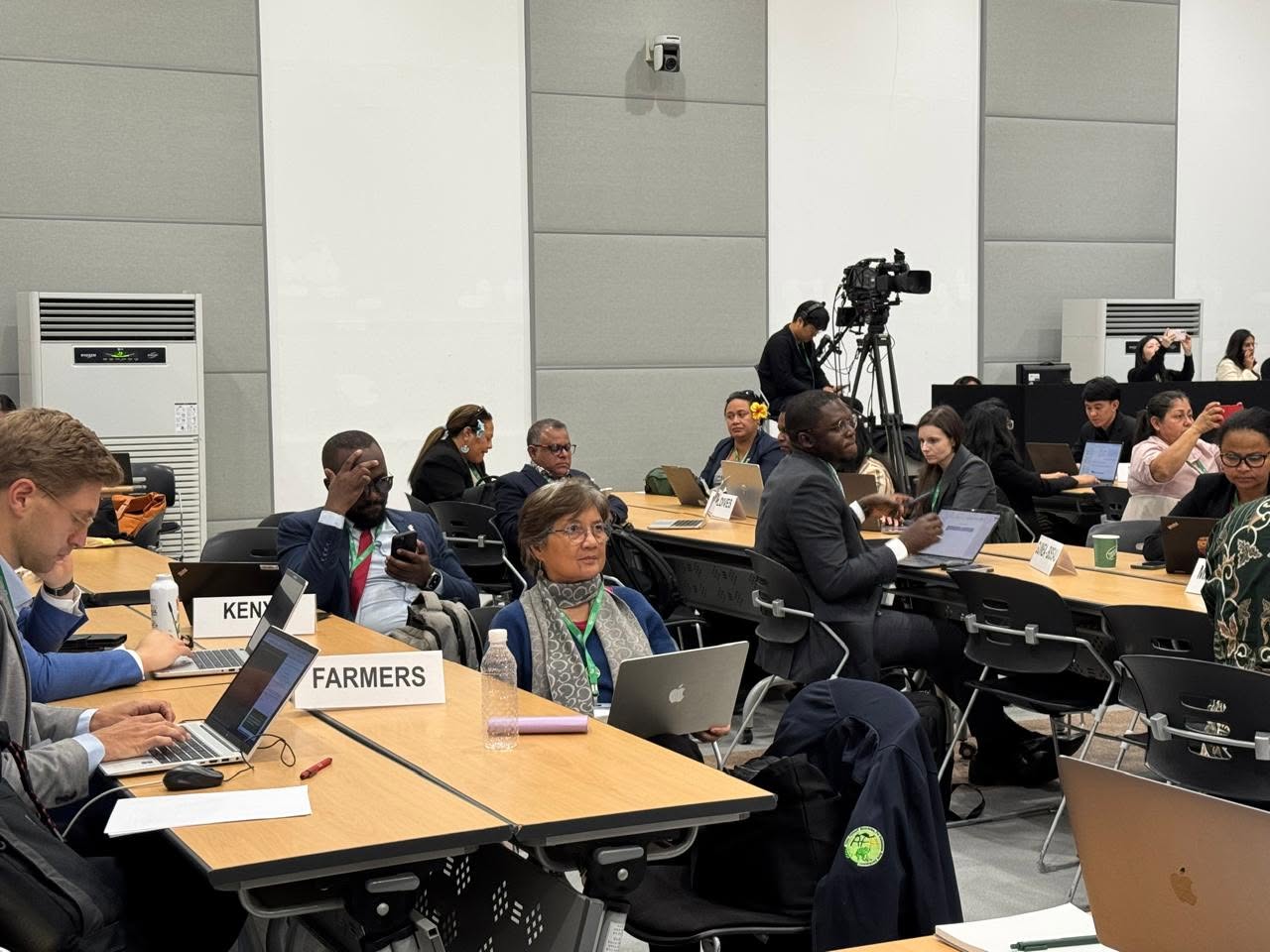
The Asian Farmers’ Association for Sustainable Rural Development (AFA) joined the third UNFCCC Climate Week, held from 19–25 April 2026 at the Yeosu Expo Center in Yeosu, Republic of Korea, bringing the voices and perspectives of family farmers into global discussions on climate action. AFA was represented by Secretary General Esther Penunia and Deputy Secretary General Lany Rebagay, who participated in Climate Week processes, knowledge-sharing sessions, networking activities, and discussions on key climate action priorities.
Representing the Farmers’ Constituency together with the World Farmers’ Organisation (WFO), AFA highlighted the important role of family farmers and their organizations in addressing climate change, particularly through agroecology, which can contribute to both climate mitigation and adaptation.
AFA emphasized that while family farmers are already contributing to climate action through sustainable and agroecological practices, these contributions need to be supported by appropriate policies and direct access to climate finance for farmers’ organizations and their cooperatives.
“Family farmers have an important role to play in mitigation through agroecology. But to fully realize this role, direct financing to farmers’ organizations and their cooperatives is necessary,” said Esther Penunia.
The discussions during Climate Week covered a range of action-oriented climate issues, including mitigation, Loss and Damage, the Belém Gender Action Plan, climate finance, and the implementation of Nationally Determined Contributions (NDCs) and National Adaptation Plans (NAPs).
For AFA, these discussions provided an important space to exchange experiences, learn from other stakeholders, and identify opportunities for farmers’ organizations to engage more meaningfully in climate action.
One of the key lessons AFA brought home from the discussions was the need to give greater attention to non-economic losses and damages experienced by rural and farming communities.
Climate change impacts go beyond lost income, crops, livestock, and infrastructure. They can also result in loss of culture and traditional ways of life, biodiversity loss, soil erosion, and significant changes in local ecosystems and communities.
Recognizing these dimensions is particularly important for family farmers, fishers, pastoralists, Indigenous Peoples, and local communities whose livelihoods and identities are closely connected to their land, forests, waters, and other ecosystems.
AFA also raised concerns around the need to ensure that energy transition and industrial decarbonization measures do not leave local communities behind.
As countries accelerate their transition toward low-carbon economies, policies and investments should include adequate safeguards to ensure that communities dependent on local ecosystems are not sidelined or displaced.
AFA stressed the importance of policies adhering to international standards on environmental protection, biodiversity conservation, responsible agricultural investments, and the protection of the rights of Indigenous Peoples, farmers, and local communities.
Decisions on what industries to decarbonize, where investments will take place, and how the transition will be implemented should involve local communities and their representative organizations through meaningful consultation and decision-making processes.
Coordination between national and subnational governments is also essential to ensure that policies are aligned and implemented coherently.
At the same time, Indigenous Peoples, local communities, and affected women and men farmers, fishers, and pastoralists need direct access to financing to strengthen their capacities for policy engagement, advocacy, monitoring, and providing feedback on how industrial decarbonization measures affect their communities.
Although Climate Week is primarily a space for knowledge exchange, learning, and dialogue rather than formal negotiations, the discussions and ideas generated can contribute to future UNFCCC negotiations and climate agreements.
For AFA, the experience also highlighted several areas for continued work. These include developing clear and adaptable messages demonstrating the mitigation and adaptation benefits of agroecology and cooperatives; documenting case studies that can be referenced in climate policy discussions and interventions; exploring opportunities under the Global Environment Facility (GEF-9); and examining the new accreditation guidelines of the Green Climate Fund (GCF).
AFA will continue to bring the perspectives of family farmers and their organizations into global climate discussions, advocating for climate policies and financing mechanisms that recognize farmers not only as vulnerable communities affected by climate change, but also as active contributors and solution providers for a more resilient and sustainable future.