
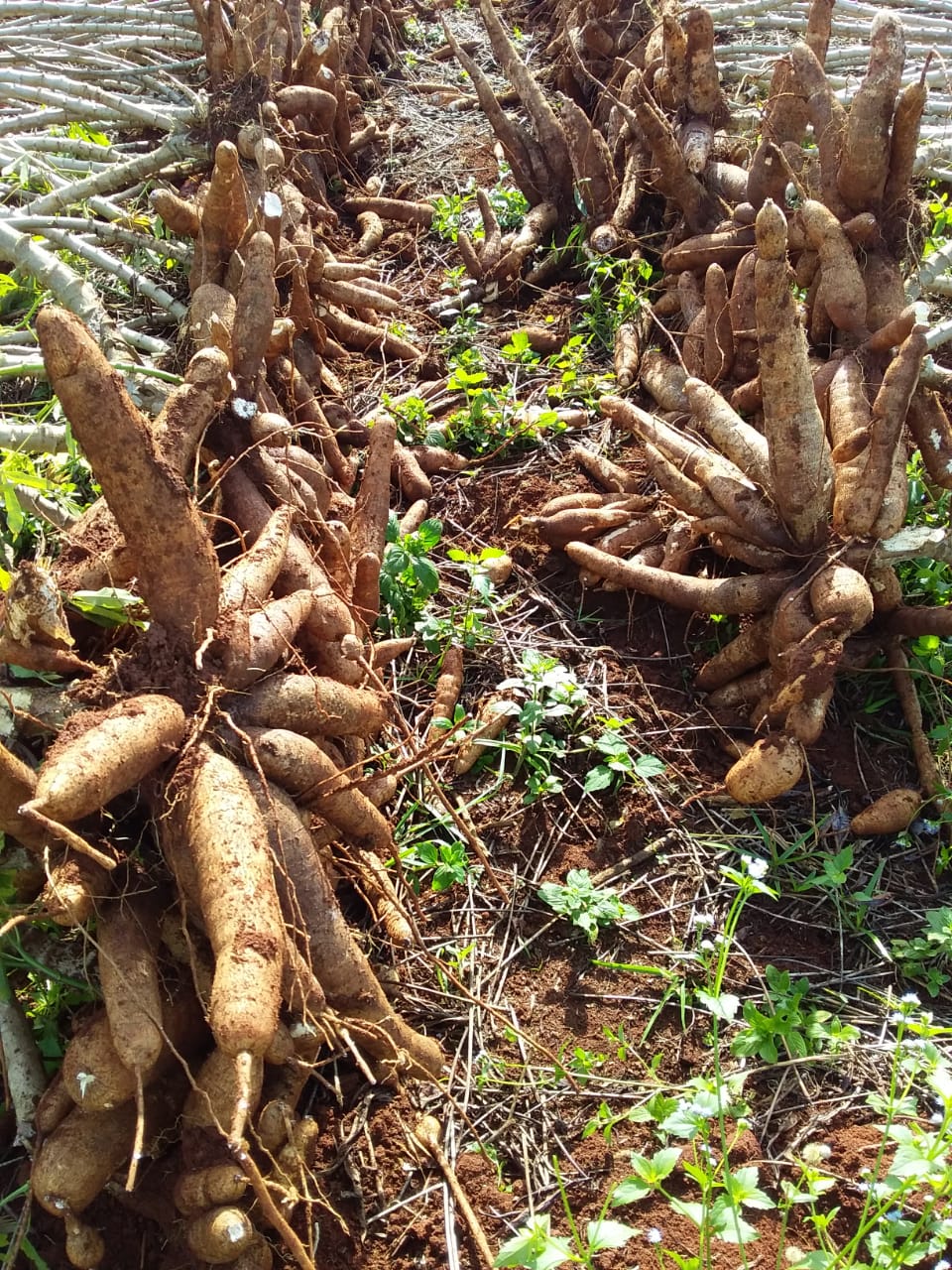


The cassava industry (specifically tapioca flour) is one of Indonesia’s priority agricultural industries due to its diverse uses as a basic ingredient in various foods, such as cakes, biscuits, noodles, premix flour, and more. However, the supply of cassava as a raw material for tapioca flour in Indonesia remains very limited compared to the expansion of the value chain at the farmer level. Meanwhile, data from 2022 indicates a deficit in the cassava commodity balance. Of the 39.8 million tons of optimal cassava raw material required for the tapioca industry, the overall supply has only reached 15.5 million tons. This presents opportunities within the supply chain industry ecosystem for cassava farmers, particularly to meet the market demand for the tapioca flour industry in Lampung Province, Indonesia.
The Wahana Masyarakat Tani Indonesia (WAMTI) (Indonesian Farmers and Fisherfolks Society) and Wamti Karya Mandiri Cooperative (WKM Cooperative) have implemented a Business Activation Plan as a supply chain in North Lampung Regency. This is a collaborative effort to realize the WKM Cooperative Revitalization Mission, which was established in 2012 but still has weak business activities. The revitalization of the WKM Cooperative allows for increased income (revenue) for cassava farmers in WAMTI’s working area in North Lampung Regency.
The Wamti Karya Mandiri Cooperative (WKM Cooperative) implements a cassava supply chain business model by organizing cassava supplies from farmers into collective distribution and marketing. This model is called Lapak. Lapak is managed by the WKM Cooperative management to distribute cassava to Tapioca Flour Industry factories in North Lampung in particular, and/or Lampung province in general. By involving at least 150 cassava farmers with a harvest area of 262.25 hectares, the WKM Cooperative plans to take advantage of the supply chain opportunities for cassava needs that are still open in Lampung Province amounting to 5.8 million tons.
Support for the Business of Wamti Karya Mandiri (WKM) Cooperative
The WKM Cooperative is an agricultural cooperative movement organized by the Indonesian Farmers and Fisherfolk Society (WAMTI). Through the Challenge Fund program of the APFP-FO4A program, the WKM Cooperative received a funding of USD 18,750 that was invested as a working capital for its cassava enterprise.
The Asia-Pacific Farmers’ Program (APFP) – Farmers’ Organizations for Asia (FO4A) was implemented by the Asian Farmers’ Association for Sustainable Rural Development (AFA) and La Via Campesina (LVC), with funding from the European Union (EU) and the International Fund for Agricultural Development (IFAD). The program aimed to strengthen the capacities of farmers’ organizations to provide economic services, advocate for enabling policies, and promote sustainable livelihoods for small-scale family farmers across Asia.
The fund is used to develop agricultural businesses with the maturity of the cooperative business. In addition, Aliansi Petani Indonesia (API), the National Implementing Agency of the APFP-FO4A program, provided capacity building, technical assistance, and business incubation to the management and members of the WKM Cooperative, including policy advocacy through lobbying, policy dialogue, and multi-stakeholder consultations.
The WKM Cooperative as an actor in the cassava industry supply chain in Lampung Province carries out core activities aimed at
- increasing income (revenue) for cassava producers;
- organizing the cassava supply chain into the WKM Lapak,
- improving direct market relations with the cassava industry.
The main service missions carried out by the WKM Cooperative are
- to be an effective supplier for cassava producers organized by WAMTI;
- to strengthen the marketing network between cassava producers and the tapioca industry with fair prices;
- to increase the income and welfare of farmers by shortening the supply chain;
- to strengthen farmer-led agricultural businesses with the support of the cooperative movement
Challenge Fund for Business Incubation of WKM Cooperative

The Challenge Fund (CF) program was implemented in North Lampung Regency, Lampung Province, for the cassava supply chain. The Wamti Karya Mandiri Cooperative (WKM Cooperative) distributes and markets the products collectively. The target group of the APFP-FO4A (Challenge Fund/CF) program for local economic development is WAMTI members in North Lampung, with a projected membership of 270 households. Meanwhile, the supports provided by the Business Development Service Staff at the National Implementing Agency Business Development Service Officer (NIA BDSO) and the WAMTI Business Development Service (BDS) are as follows: capacity building, technical assistance, and business incubation. The results of the business incubation are: identification of WKM Cooperative business activation services, input for the preparation of the Cassava Supply Chain Development Business Plan, WKM Cooperative Business Activation, increased capacity for developing cassava processing, WKM Cooperative Business Plan on the cassava supply chain, increased skills of village women to produce mocaf in North Lampung, increased knowledge of financial management, setting up
a computer-based accounting system, increased financial recording skills in the accounting system, and stock control forms.
Implementation of WKM Cooperative Business
One of the business activities of the Wamti Karya Mandiri (WKM) Cooperative is to absorb and purchase cassava raw materials from members. The WKM Cooperative’s business processes include: (i) organizing cassavaproducing farmers, (ii) purchasing cassava from cassava-producing farmers (iii) distributing cassava to tapioca factories.
The business activities carried out by the WKM Cooperative from January 1, 2024 to December 31, 2024 resulted in the organization of 300 cassava-producing farmers, the purchase and distribution of 1,026,270 kg of cassava.
As with cooperatives in general and government regulations, the Cooperative’s equity resources are obtained from Principal
Savings, Mandatory Savings, and Grants. In addition, equity capital is obtained from liabilities. During 2024, the Wamti Karya Mandiri Cooperative (WKM Cooperative) has accumulated equity and liabilities totaling Rp.383,218,980 (USD 23,951.18). The total utilization of available working capital of Rp.383,218,980 (USD 23,951.18) is to fund production and operational costs.
From October 1, 2024, to December 31, 2024, the Wamti Karya Mandiri (WKM) Cooperative has purchased 1,026,270 kg of cassava, with a nominal value of Rp.1,026,430,000 (USD 64,151.88). The cassava purchases came from farmers who are members of the WKM Cooperative. Meanwhile, the amount of cassava sold was 1,026,270 kg. The WKM Cooperative supplies the cassava to several buyers such as the Tapioca Factory. The total turnover of the WKM Cooperative is Rp.1,195,555,341 (USD 74,722.21).
WKM Cooperative Income

The revenue of Wamti Karya Mandiri (WKM) Cooperative is defined as the result of total sales minus the total cost of goods sold and total overhead costs. For the period from October 1, 2024 to December 31, 2024, the total turnover of WKM Cooperative was Rp.1,195,555,341 (USD 74,722.21). While the total cost of goods sold was Rp.1,137,144,150 (USD 71,071.51); total overhead costs were Rp.21,557,800 (USD 1,347.36). Thus, the total expenses during this period were Rp.547,125,553 (USD 34,195.35). Therefore, the net income earned by the WKM Cooperative in the period from September 1, 2024 to August 31, 2025 is Rp.59,858,947 (USD
3,741.18).
Impact and Learning
APFP-FO4A support for the Local Economic Development of the WKM Cooperative through the Development of the Cassava Supply Chain Business in North Lampung Regency has improved the economic ecosystem in rural areas. This contributes to increasing the income and livelihoods of smallholder farmers, food and nutrition security, and the security of family farming in rural areas. In this case, agricultural cooperatives led by farmer organizations are important actors in the development of the economic ecosystem in rural areas. The economic turnover of Rp.1,195,555,341 (USD 74,722.21) achieved by the WKM Cooperative shows that this cooperative contributes to increasing the income of smallholder farmers, especially in
North Lampung Regency.
Based on these facts, APFP-FO4A support has increased the income of 446 people including small farmers, both men, women, and youth. By strengthening Wamti Karya Mandiri (WKM) Agricultural Cooperative in North Lampung Regency, the cooperative
contributed to increasing the income of small farmers and other communities by an average of Rp.2,614,757 (USD 163.42). In fact, it increased the income of 300 cassava small farmers by Rp.3,420,900 (USD 213.81). While at the same time, the cooperative was able to increase the income of 10 employees and staff by more than Rp.2,250,000 (USD 140.62).
With various capacity-building services provided to the WKM Cooperative, such as training, technical assistance, and business incubation provided by the farmer organization (FO), the national farmer organization (NFO), and the National Implementing
Agency (NIA) to farmer members and staff of the Cooperative, as well as the board of directors, their knowledge and skills in cultivation, supply chain improvement, cooperative management, and market access have also increased. At the same time, farmer
participation in the cooperative has also improved. This means that 446 people are involved in the cooperative and implementing a business ecosystem.
Cassava, the raw material for tapioca flour, is a climate-dependent commodity. Farmers harvest cassava during the rainy season. Outside of these climatic conditions, farmers sell cassava for urgent needs, driven by high prices offered by buyers or rising flour prices, followed by factory prices. This climate-related situation limits cassava purchases by WKM Cooperative members,
necessitating a broader identification of potential locations. The cooperative’s highprice offering strategy cannot be realized if it is not aligned with rising factory prices.
Supply through WKM kiosks remains relatively limited. This results in insufficient absorption capacity to meet the minimum volume set by the factory (the factory’s marketing channel). Of the three WKM kiosk marketing channels, some of the kiosks
have successfully partnered with the factory. The remaining cassava is sold to larger kiosks to avoid significant losses due to shrinkage. Furthermore, intense competition exists between the numerous kiosks spread across each production area, making it
easier for the factory to reduce prices.
Opportunities to Increase Business Scale and Employment in Rural Communities
In the early stages of business activation, the cooperative’s human resources still need to learn and familiarize themselves with standard operating procedures and good governance for internal control purposes. Today, the WKM cooperative’s human
resources have been able to operate the financial system effectively, enabling them to generate financial reports through it. Human resource regeneration within the cooperative is necessary to address opportunities for developing the cassava processing
business.
In the initial stage of the cassava supply chain business activation program, the WKM Cooperative involved 3 WKM kiosks as purchasing channels for 22 cassava farmer households who own/rent land with an average gross income of Rp.16,113,548 per
average of 0.75 hectares, and 18 landless catfish farmers with an average income of Rp. 4,091,664 for 3 months. Now the cassava supply chain business developed by the WKM cooperative provides additional employment for local residents, including WKM
cooperative staff, cassava loading and unloading workers, transportation service providers, and others.