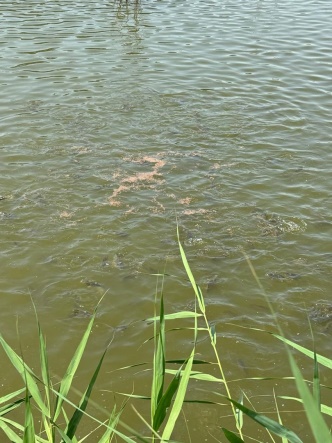
What was once an abandoned stretch of land covered in dense vegetation is now becoming a productive fish farm, providing new opportunities for farmers and strengthening the livelihoods of members of the IRADAN LTD Agricultural Cooperative in Kyrgyzstan.
Led by Director Kasymov Asylbek, IRADAN LTD currently brings together 12 member leaders representing approximately 450 farmers. In 2024, the cooperative expanded beyond crop production and ventured into fish farming, with a USD 9,500 support from the APFP-FO4A program. The Asia-Pacific Farmers’ Program (APFP) – Farmers’ Organizations for Asia (FO4A) was implemented by the Asian Farmers’ Association for Sustainable Rural Development (AFA) and La Via Campesina (LVC), with funding from the European Union (EU) and the International Fund for Agricultural Development (IFAD). The program aimed to strengthen the capacities of farmers’ organizations to provide economic services, advocate for enabling policies, and promote sustainable livelihoods for small-scale family farmers across Asia.
“Before this, we bought and bred local fish fry ourselves, but they did not grow as we expected,” Asylbek explains. “This time, thanks to the new high-quality fry, we expect a very good result.”
Through the project, the cooperative purchased and stocked approximately 20,000 white amur and carp fry, each weighing around 100 grams. The investment has already begun to show results, with the fish demonstrating stronger growth than previous batches.
Turning neglected land into a productive farm
For fish expert Mansurov Kasimzhan, the fish farm is the result of years of hard work. He has been leasing the land for more than seven years and began developing the fish farm in 2019. At the time, the area consisted largely of abandoned land covered by dense vegetation. He cleared the property, secured the necessary permits and began constructing the ponds.
The farm initially consisted of two ponds covering about two hectares each. However, the first batches of carp fry failed to reach the expected size. Even after trying another breed, growth remained below expectations. A new opportunity came when Kasimzhan joined IRADAN LTD. With the support from APFP-FO4A, the farm was able to access higher-quality white amur and carp fry.
“The difference is already visible,” Kasimzhan says. “We are seeing good growth from the new fry.”
Developing the farm has required significant investment. Around 3.5 million soms has already been spent on earthworks, cleaning, pond improvements and other infrastructure. The cooperative also purchased a 45-ton container to safely store fish feed.
Investing in better feed for better growth
Good-quality fry is only one part of the equation. The cooperative is also investing heavily in nutrition to ensure the fish reach their full potential.
Around 40 tons of feed have been purchased, including wheat, corn and other feed materials. The fish are fed twice a day, with approximately 300–400 kilograms of feed provided each morning and evening.
The cooperative has also established an agreement with a specialized fish-feed manufacturer in Iran. The feed is transported through Uzbekistan and is formulated with vitamins and minerals to support faster and healthier fish growth.
The first shipment of 2.5 tons has already arrived and is being used on the farm, with another five tons ordered.
“The new fry have already eaten about 20 tons of our multivitamin feed,” Kasimzhan says.
Working with nature
The cooperative is also incorporating agroecological practices into its fish-farming system.
Along the edges of the ponds, the farmers have planted trees such as apricot and titovnik. These plants help stabilize the soil around the ponds, provide shade for the fish and contribute additional organic food resources during the fruiting season. At the same time, the fruit can provide an additional source of income for the cooperative.
The cooperative has also purchased equipment for mowing reeds growing along the pond banks. White amur naturally feed on reed leaves, allowing the farmers to make productive use of vegetation growing around the ponds.
The process is simple but efficient: reeds are cut, collected and provided as additional feed for the fish, while the remaining vegetation can be cleared to maintain the ponds.
“Our tractor is very useful for these small jobs,” Asylbek says. The cooperative has also modified its equipment to better suit the specific needs of its fish-farming operations.
Securing water and feed for the future
Water for the ponds comes from a channel connected to mountain rivers. Special gates allow the farmers to regulate the water level, helping them maintain suitable conditions for fish production.
The cooperative is also working to strengthen its feed supply. On 1.5 hectares of land allocated specifically for the cooperative, members are growing corn that can be used as feed for the fish.
By producing part of its own feed, the cooperative can reduce dependence on external suppliers while making better use of its agricultural land.
A new source of opportunity
For IRADAN LTD, fish farming represents more than simply adding another product to its cooperative activities. It is an opportunity to diversify farmers’ livelihoods, make productive use of previously neglected land and create a more integrated farming system.
The cooperative’s experience also demonstrates the importance of access to quality inputs. After several unsuccessful attempts with locally sourced fry, the introduction of high-quality fish stock, improved feed and better farm infrastructure is giving the farmers renewed confidence.
With its ponds improving, feed systems strengthened and agroecological practices integrated into production, IRADAN LTD is looking ahead to a productive future.
“We are very grateful for this project,” Asylbek says. “We expect a very good result.”
For the cooperative and its approximately 450 farmers, that result could mean more than bigger fish. It could mean a new and sustainable source of income built from land that was once considered unproductive.